

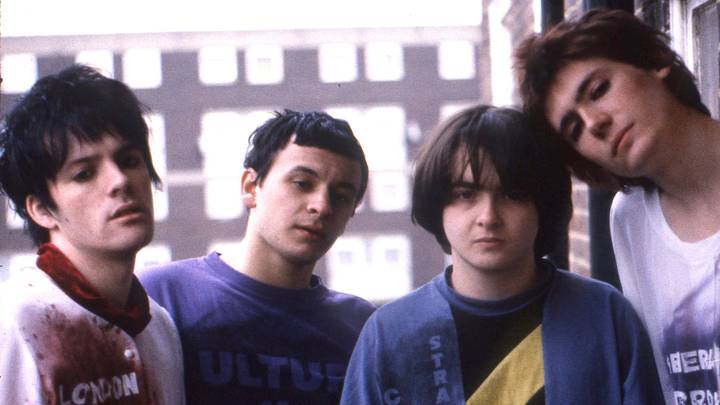
Top 10 Manic Street Preachers songs
10. “Judge Yr'self”
This is likely one of the more unorthodox placements on this entire list, but I’ve long held this Holy Bible-era deep cut in high regard, as it sounds unlike much of the Manics’ discography. The pounding crunch of Bradfield’s guitar gives way to a slippery bass part courtesy of Wire, and Bradfield’s bellowing vocal delivery wouldn’t sound out of place on a metal album from the early 1990s. It’s a straightforward track that punches right in the gut.
The riff is incredibly memorable, and the obtuse lyrics will leave you guessing as the song’s thesis statement. Even with those elements muddying the waters, the visceral impact of this stunningly powerful rarity cannot be overstated. This track showcases the immense breadth of top-tier material that the Manics’ discography is replete with.
9. “This Is Yesterday”
Another unusual choice for a top 10 Manic Street Preachers song, “This Is Yesterday” is the only sliver of sunlight that the band grants you on an album that is punishingly harsh, endlessly abrasive and an exploration of those that don’t “want virtue to exist anywhere.”
With lyrics mostly by Wire, the tender, pillowy melody and instrumentation of this track serve as a distinct counterpoint to the thunderously heavy songs that surround it on all sides, including “Faster” right before it and the double-whammy of “Die in the Summertime” and “The Intense Humming of Evil” right after.
The album is already an intensely harrowing listen that leaves behind meaningful scars, and without the delicate contrast provided by “This Is Yesterday,” The Holy Bible might even be too heavy. Due to its presence, the album gives you the briefest shimmer of hope, before shutting the door completely with the album’s final three tracks.
P.S. – The guitar solo from James Dean Bradfield on this song is one of his best of all time.
8. “Kevin Carter”
Based on the talented photographer of the same name who took the famous Pulitzer Prize-winning photograph, The Vulture and the Little Girl, which showed a starving boy (not a girl, actually) in war-torn Sudan (now South Sudan) being followed by a vulture as he attempted to reach a UN feeding center.
While powerful, the photo was inherently morbid and a difficult one for the masses to deal with. Carter, a sensitive soul, committed suicide four months after winning the Pulitzer at age 33, and the Manics documented this entirely tragic affair via an angular, post-punk-infused transmission on Everything Must Go.
Arguably one of the group’s finest soundscapes (just listen to the instrumental version), this track’s tragic backstory is underscored via a lovely yet morose trumpet solo from drummer Sean Moore. This song has aged exquisitely, and its jazzy chords and intricate guitar layers still sound unlike anything the Manics produced before or after. A classic.
7. “4st 7lb”
One of the saddest and most distressing songs on an album utterly rife with them, this disturbing song about Edwards’ bouts of anorexia and body dysmorphia is, once again, given a breathtakingly beautiful coda via one of the most stunning melodies that Bradfield ever wrote.
While the beginning of the track is typical Holy Bible—slashing guitars, urgently belted vocals from JDB, disturbingly poetic lyrics from Edwards—the end truly ties the whole thing to a painful, obliterating finale that sees the narrator of the song, in this case, Edwards, finally accepting and even welcoming their tragic, dire situation:
“Yeah, four stone seven: an epilogue of youth; Such beautiful dignity in self-abuse; I've finally come to understand life through staring blankly at my navel.” A painful listen, but one that is once again lifted by Bradfield’s knack for making a line as cutting and heartbreaking as “I want to be so skinny that I rot from view,” into a catchy chorus.
While that could be construed as glorifying self-harm, in my eyes, it reads as putting one person’s (Edwards’) tremendous pain and internal turmoil into memorable song format, and highlighting the troubled artistic process of one of the 1990s’ most talented – and most fraught – figures. RIP Richey.
6. “William's Last Words”
Speaking of RIP Richey, the final song on Journal for Plague Lovers is arguably the most powerful song ever recorded by the Manic Street Preachers. The song’s lyrics truly read like a suicide note from Richey to his friends, family, and bandmates.
The fact that the Manics deliver those words with a fitting musical tribute on an album that literally has his fingerprints all over it showcases the group’s songwriting mastery – as well as the tremendous psychic and cultural hold that Richey still retained over the group and its fans.
Arguably the shrewdest decision upon recording this song was to allow Nicky Wire to sing lead vocals on it. Wire and Edwards had long been the closest of confidantes, and Richey’s loss assuredly tore Wire apart. You can hear the intense emotional impact that Edwards still had on Wire, as you can audibly hear him choking back tears while he croons the song’s final line:
“Yeah, I'm really tired, I'd love to go to sleep and wake up happy; wake up happy.”
5. “No Surface All Feeling”
With a title phrase that’s shorthand for “don’t judge a book by its cover,” this track’s catchy slogan of a title also seems to represent the Manics’ entire ethos: it might not sound or look pretty (see Jenny Saville’s two distressing album covers for the group), but what you will find within the run time of their albums is nothing but eminently rewarding and extremely well-crafted songs—all of which sound totally and completely like “the Manics.”
The closing track from 1996’s Everything Must Go typifies that album.
While the group were still reeling from the loss of their beloved bandmate Edwards, a feeling they would never truly shake, even after the personal reckoning related to Edwards’s disappearance found on 2009’s Journal for Plague Lovers, they managed to pick themselves up, employ some of Richey’s leftover lyrics and deliver some of their finest songs ever up to that point—all buoyed commercially by the rise and continued chart power of Britpop.
While “No Surface All Feeling” features one of the band’s best-ever guitar riffs, it’s that skyscraping chorus and the notable “soft/loud” dynamics (a space the group rarely played in) that will keep you coming back for more. An incredible track, and a fitting start for the top five.
4. “Faster”
“I know I believe in nothing, but it is my nothing!” The Holy Bible’s thesis statement showcases the lyrical mastery of Richey Edwards, perhaps better than any other song in the Manic Street Preachers’ entire discography. Every single distinct couplet and twisted, thorny syllable is a memorable act of manipulating the English language to perfection.
JDB is up to the task in crafting a song that shines a spotlight on those powerfully abstruse lyrics by delivering arguably the most memorable melody from the group’s 1994 album. Repeating a trick he and the band do throughout Bible, Bradfield makes the line “I am idiot drug hive, the virgin, the tattered, and the torn” into an eminently catchy singalong chorus—which is no small feat.
Beyond the melody, Bradfield’s guitar work typifies The Holy Bible: angular yet perfectly sculpted, both the somewhat atonal riff and the off-the-wall guitar solo represent everything that the group’s finest album proffers to listeners: It might not be the easiest listen, but it is among the most rewarding albums to experience in totality across music history.
3. “Peeled Apples”
A punishing, pummeling track that relentlessly batters you with powerful imagery, memorable phrasing, and some of the best music of the Manics’ career, “Peeled Apples” represents the pinnacle of the group’s mid-to-late career and serves as a high point for the group well over 20 years after they formed.
Journal for Plague Lovers remains one of the band’s crowning achievements, and the first track on the album is one of the main reasons why. Employing leftover lyrics from their dearly departed comrade Richey Edwards meant that the album was always going to be suffused with a reverent sadness.
However, instead of delivering watered-down acoustic ballads honoring their dear friend, the group aimed for the stratosphere and attempted to deliver an album on par with their magnum opus and Richey’s crowning lyrical achievement: 1994’s The Holy Bible.
Somehow, the group pulled it off, and the album is littered with all-time classics – the best of which is “Peeled Apples,” a song that should serve as one of the first songs to introduce Manics neophytes when you’re attempting to convert someone into a fan. Seminal.
2. “Motorcycle Emptiness”
“Motorcycle Emptiness” is a widescreen manifesto that elevates the group’s debut album, Generation Terrorists, from “interesting curio from the era” to “classic debut album” in one fell swoop, thanks to the swooning, peerless guitar riff, played by Bradfield with a tone so syrupy that it wouldn’t be out of place spooned over the top of your morning waffles.
An incredible achievement, especially for a group so young at this point, the Manics exceeded all expectations and showed all naysayers that they were the real deal (or “4 REAL” in Richey’s parlance) with a song that is fairly well-known among true music omnivores, but still not placed in the pantheon of “all-time classics” by most major publications.
For the Manics, that’s just fine, as it has always been about “The Masses Against the Classes.” Even if a song as objectively perfect as “Motorcycle Emptiness” doesn’t get the widespread acclaim it deserves, devoted fans of the group will hold it close in their hearts and share it like a blazing badge of honor among themselves, all the while they bellow the song’s iconic chorus in unison: “Under neon loneliness, motorcycle emptiness!”
1. “A Design for Life”
When I first heard this song as a college sophomore, it felt as if I was hearing my own thoughts beamed into my headphones from almost 20 years prior by a band from the far-off nation of Wales. I was immediately hooked on the Manics, and I haven’t quit them since.
“A Design for Life” is the Manic Street Preachers’ magnum opus. It is an edifying, triumphant anthem that manages to be among the group’s biggest hits as well as their best song overall. That’s a rare feat, to be sure, but when a song is this powerful, life-affirming, and flawless, the intersection of widespread commercial and critical acclaim simply makes sense.
For a group known for verbose, hyper-literate, historical reference-soaked tracks, it is rather surprising that their best song boasts only two distinct verses, one of which is repeated twice (“I wish I had a bottle…”). While somewhat head-turning, this shows that the band knows what a good song needs, no matter whether it is “in their style” or not.
In this case, the sweeping majesty of this track, which is underscored by the emotive swells of a string section, requires only those verses, an eminently memorable pre-chorus (“We don’t talk about love…”) and the bellowed chorus repeated as a litany: “A design for life!”
Brilliant songwriters like Bradfield, Wire, and Moore understand that, sometimes, less is more when it comes to delivering exactly what a song needs. If you’re looking for a way to introduce the Manics to neophytes or nonbelievers, start here.
While some might view this track’s repetition as a weakness or as an example of the group not giving it their all, to me, it turns this song into a repeatable mantra that represents an entire way of life. A design for life, perhaps.
A thrilling, masterful discography
While the 50 best Manic Street Preachers songs are full of difficult and sometimes painful topics, the music remains incredible, and the trio is still making notably interesting musical decisions as we bear down on the late 2020s.
Perhaps their early albums feature the group’s best material, but the sheer fact that Bradfield, Wire, and Moore continue to make good music should give all forward-thinking people hope in this wild world we live in.
 Add us as a preferred source on Google