

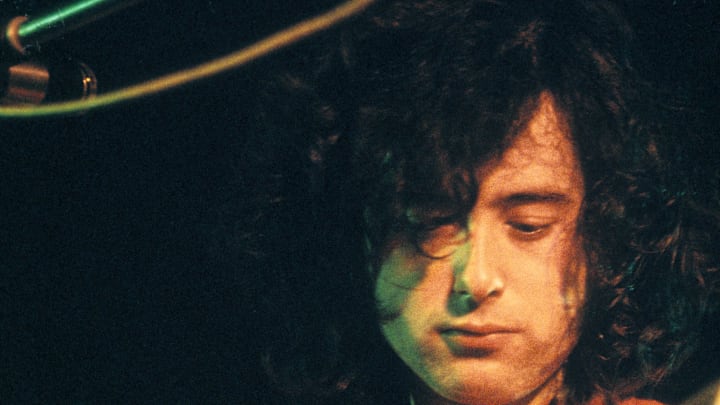
There was a time when the guitar was more of a background instrument in a pop music ensemble. In the early part of the 20th century, pianos and saxes were more likely to stand out as the showy lead instruments. Guitars – acoustic at the time – operated more as rhythmic devices, closer to the bass and drums than how we see them today.
Electricity changed that. Guitars got louder and more prominent. Soon, a plethora of pedals were permitting a wide range of effects. It was a symbiotic relationship with rock & roll. As rock gained prominence, so too did the guitar.
Though the guitar gods of rock’s early growth period were known for their work with electric guitars, they could all play acoustic. And the best of them recognized that an old-fashioned acoustic could add a warmer tone when such a sound was desirable. So even though it may have been surpassed by its solid body cousin, the acoustic guitar never vanished from modern popular music.
The best acoustic songs of the rock era
I’m calling this list the best acoustic songs of the rock era, but I need to point out several qualifiers. First, I am not confining myself to rock & roll songs – not in the strictest sense at least. Rock was dominant enough through its heyday that it had an impact across many genres.
So I am throwing in some great acoustic numbers from the world of folk, country, and bluegrass, all of which at least have a tangential relationship to the classic rock era.
Second, I’m cutting this off at 2000. (The year – not the number of songs). Check out Billy Strings’ “Dust in a Baggie” or Molly Tuttle’s “Side Saddle” if you want some more current examples of great acoustic numbers. Quite frankly, I had to stop at 2000 because this list would have never ended if I hadn’t done so. Perhaps one day we’ll do a follow-up. But not today.
Finally, my definition of “song” for this list means that there is a vocal component. The greatest acoustic guitar music I have ever heard tends to come from classical and jazz traditions that are somewhat removed from modern pop. Most of these compositions feature the guitar alone, or with other minimal accompaniment. None of them have lyrics.
Artists ranging from Leo Kottke to Kaki King have produced sensational acoustic guitar instrumentals. There are a lot of sharp music lovers who will tell you Tommy Emmanuel is the greatest acoustic player of all time. For me, Al Di Meola’s “Mediterranean Sundance” is the single greatest piece ever created on an acoustic guitar.
None of them are included.
So what is on the list? I didn’t merely look for great songs in which the acoustic guitar is the featured instrument. I tried to find songs in which the guitar part was interesting in its own right. A catchy riff or an ear-grabbing picking style.
But the guitar should not dominate. It may show off for a little while, but it has to remain a piece of a greater whole. Some of the following selections feature intricate performance. Others do not, but they integrate so beautifully into the song that they are ultimately more effective than players with greater technical virtuosity might manage.
In other words, what follows is not a list of the greatest acoustic players, though some of the choices may qualify for that. These are first and foremost great songs that happen to be constructed upon an intriguing acoustic guitar base.
In chronological order…
“Don’t Think Twice, It’s All Right” by Bob Dylan (1962)
Musicians who have played with Dylan love telling stories about he will slip in and out of keys in the middle of songs. No one has ever claimed that the Nobel Prize-winning songwriter is among the greatest players in the world of folk rock.
But Dylan has always known how to create interesting guitar parts in service of his songs. The intricate finger picking that underpins a relatively simple chord progression is a perfect bed for this wistful tune, that might have bordered on pathetic if not for the lively guitar.
“Blackbird” by the Beatles (1968)
This may be the best-known acoustic rift in the early history of rock music. I think Paul McCartney wrote better songs, but there is no denying the beauty of his lyric and melody, and the guitar provides lovely emotion. This is the song that every acoustic guitar player in the ‘70s was most eager to master.
“Chelsea Morning” by Joni Mitchell (1969)
“Chelsea Morning” came from Mitchell’s second album Clouds. A couple years later, her fourth album Blue would feature an astonishing array of songs, many of them built on her guitar. As a guitar song, I like “Chelsea Morning” best of all. It has the wandering jazz spirit that Mitchell would explore more and more as her career progressed. Here, it is bright, intricate and engaging.
“Can’t Find My Way Home” by Blind Faith (1969)
We’ll soon get to even better proof that electric guitar gods could also be supreme acoustic players, but for now, we have Eric Clapton. His lovely and expressive guitar supports Steve Winwood’s mysterious song and ethereal vocals perfectly.
“Friend of the Devil” by the Grateful Dead (1970)
Another relatively simple descending melodic scale made unforgettable by the way Jerry Garcia chooses to present it. The Dead often played it with electric guitars in live shows but hearing Jerry and Bob Weir trading off acoustic runs is the song at its best.
“Turn on Your Radio” by John Hartford (1971)
OK, this is basically bluegrass with a tinge a gospel. Maybe it doesn’t belong on a list of songs that are at least rock-adjacent. Then again, John Hartford, who could play pretty much anything with strings at an elite level, was always difficult to pigeonhole.
So we’ll let these stand for all those glorious finger-picking tunes that borrowed an attitude from rock & roll despite remaining firmly in their own genre.
“Going to California” by Led Zeppelin (1971)
Jimmy Page was the best of all the electric guitar gods at incorporating magnificent acoustic passages into rock and roll songs. This one is about as beautiful as it gets. “Over the Hills and Far Away,” from a few years later, featured an even more ambitious acoustic part but after about 90 seconds, it gives way to the Page’s electric guitar.
“The Needle and the Damage Done” by Neil Young (1972)
From his Harvest album, Young was equally proficient at rocking out or slowing it down with a more expressive, intimate acoustic. The galloping chord progression here is a nice counterbalance to the profound despair of the lyrics without ever losing the tenderness in the message.
“Jolene” by Dolly Parton (1973)
Another non-rock song that was clearly influenced by rock. Parton wrote dozens of great songs for herself and for others but this may be her most iconic. A classic country message which could have been a maudlin plea to a Queen Bee manages to be both tough and haunting.
The propulsive guitar provided by Chip Young is supplemented by a second guitar part played by Wayne Moss. This song can be played in a variety of styles, from traditional country to outright punk rock. No covers have topped Dolly’s original.
“Wish You Were Here” by Pink Floyd (1975)
I stopped being surprised long ago by how many people choose this as their favorite Floyd song. David Gilmour is another electric virtuoso who works magic with an acoustic. He counterpoints himself here with two radically different modulated acoustics. The verse itself features a relatively simple strummed chord pattern as other instruments step forward, but that acoustic intro is bliss.
“I Should Have Been Home” by Blaze Foley (1975)
Foley may not have been a virtuoso on guitar. To be honest, he wasn’t really around long enough nor did he achieve enough fame to reveal what he might have been capable of.
But what we do know on songs like “Clay Pigeons,” “Big Cheeseburgers & Good French Fries” and this tune, is that he had the rare ability to marry interesting guitar support to some of the sharpest songs of the 1970s. This borrows from the Greenwich Village folk vibe of Dave Van Ronk but brings some Texas doom into the playing.
“Redemption Song” by Bob Marley (1980)
Some historical perspective applies here. When it first came out, this song stood out not merely because of its beauty and grounded optimism, but because of how much of a departure the simplicity of one acoustic guitar was from what we all were expecting from Marley.
There’s a bit of shuffle underneath the vocal that fits so perfectly it’s as if Marley had been singing like this his whole life. Marley wrote and recorded it while the cancer that would soon take his life was rapidly spreading through his body. Seven months after “Redemption Song’s” release, he was dead.
“Fast Car” by Tracy Chapman (1988)
Chapman’s debut single took the world by storm. The simple guitar riff over the barest of drums and bass instantly set the tone of longing, and Chapman’s potent songwriting and vocal builds on it. For two minutes, that motif is a drone that hints at those unfulfilled dreams. Then, on the chorus, a fuller band enters, though still built on Chapman’s acoustic.
The brilliance of the composition is how she layers more and more energy into successive choruses while always returning to that yearning little motif which reminds us of the perpetually unfinished business at the heart of the song.
“1952 Vincent Black Lightning” by Richard Thompson (1991)
Acoustic songs just don’t come better than this. Thompson is among the greatest technicians on the instrument and this song is his towering tribute. The lyric is outstanding as well, telling of an ill-fated love affair between a young criminal and a girl with red hair and black leather. Thompson’s intricate finger picking sucks in any listener for the ride.
“Wolf at the Door” by Patty Larkin (1997)
Larkin has taught at Boston’s legendary Berklee School of Music, where many sensational guitarists put in some time. She had studied there as well, honing her guitar chops and facility with jazz composition.
This song shows off all her prodigious talents as well as anything she ever released. When at her best, Larkin does for an acoustic guitar what Stevie Wonder did for the Clavinet. And this is her at her best.
I’m looking back and realizing I left out iconic acoustic players like James Taylor, Paul Simon, and Nancy Wilson. I suppose anything from Springsteen’s Nebraska would have fit right in.
But you have to draw the line somewhere. If these 15 songs aren’t the absolute best, I’m content with what they offer. Feel free to drop me a line with suggestions should I work on a volume 2.
 Add us as a preferred source on Google