

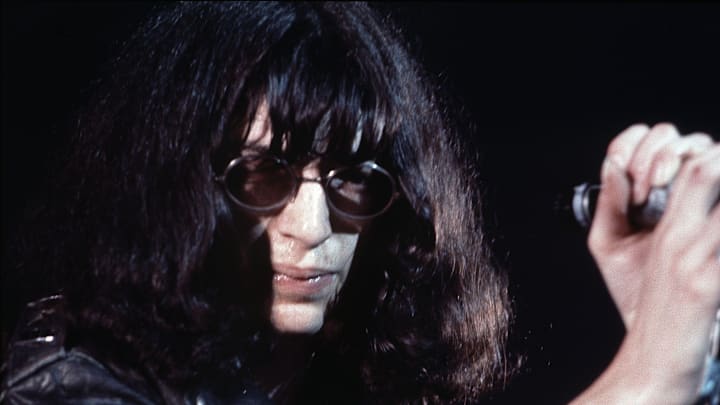
“One, two, three, four!”
Of course, we all knew how to count before April 23, 1976. But for music fans, no one would ever say those four numbers quite the same way after hearing Dee Dee Ramone count in “Blitzkrieg Bop.” It wasn’t just the speed. It was the urgency. Something vital was happening, and music was the only proper avenue for its reveal.
Actually, you could have heard Dee Dee and Joey and the boys – four kayfabe brothers from New York City and its suburbs – singing “Blitzkreig Bop” for a couple of months before the eponymous debut album drop. Sire released it as a single in February. But no one really bought it. No one ever really bought Ramones singles.
But their albums and their live shows – the mere fact of their existence in the music scene – those would all have an outsized impact on the industry and on the culture. And for many of us, it began fifty years ago this month. It began with “One, two, three, four.”
Ramones turns fifty, but remains a teenager at heart
Was Ramones the first punk album? That’s a great way to start a major fight on the pages of Reddit. I have an album featuring 14 songs from the mid-1960s, which is the second volume of the iconic Nuggets series. It is subtitled “Punk.” The Vagrants have a track. Song titles include “Strychnine” and “Spazz.” They all sound pretty punk to me.
Others will tell you the Monks or the Kinks – or MC5 or Iggy – or … (fill in the blank with your favorite band here) were the true inventors of punk. You can make whatever case you like because punk rock isn’t really a genre. It is something more than that.
I used to teach and lecture on film history, and I have always found punk rock to be a spiritual cousin to film noir, a popular ”genre” that emerged in the post-WWII era to express a profound dissatisfaction with the status quo. The deeper you dive into film noir, the more you have to recognize that it is not so much a genre of film – characterized by recurring motifs and stylistic uniformity – as an attitude toward life.
Punk rock is a feeling more than a genre. Or maybe a statement of intent. Regardless of what may have preceded it, that statement was formalized with Ramones.
It is codified in the speed of Dee Dee’s countdowns. In the brevity – no song exceeds three minutes, and half of the 14 tracks run two minutes or less.
It is there in the simplicity – a few repeated chords. A few repeated words. And in the urgency. You are almost compelled to move and to sing along. They were Americans, but there was something profoundly “Oi” in the music. They were punk, but there was something metal.
If you want to understand why Ramones is indeed the proper album to begin the proper history of punk, look to the lyrics.
“Now I wanna sniff some glue
Now I wanna have something to do.”
“Sittin’ here with nothing to do
Sittin’ here thinking of you
But you’ll never get out of there
She’ll never get out of there.”
“53rd and 3rd
I’m tryin’ to turn a trick
53rd and 3rd
You’re the one they never pick
53rd and 3rd
Don’t it make you feel sick?”
Those songs – “Now I Wanna Sniff Some Glue,” “Chain Saw,” “53rd and 3rd” – they captured an ethos. A generational vibe that was different from the earlier decades of rock and roll. Dee Dee’s “53rd and 3rd” references the Vietnam War by name, but that would be an outlier. Ramones weren’t political, at least not in the sense that they sang about the war and the economy and the government.
Dee Dee and Joey, the primary songwriters, sang about the everyday life of a kid growing up in 1970’s America. After “Blitzkrieg Bop” opens the album, there is the extraordinary double shot of portraiture – “Beat on the Brat” and “Judy is a Punk, “ both songs written by frontman Joey.
What makes them stand out is the very fact that they have nothing constructive to offer to any conversation about the youth of the ‘70s.
“Beat on the Brat” might function as a primer for the far right of contemporary evangelicalism, but it hardly seems like proper parenting advice. As for Judy … the most that the band can offer is to join the Ica Capades –one of the funniest lines in all of ‘70s music.
The Ramones were not great musicians, but they had a lot more going for them than many of their forerunners. On that first album, the drummer was Tommy – AKA Thomas Ederlyi – who soon gave up the drum kit and moved behind the scenes as an accomplished producer.
And in Johnny, they had one of the most influential rock guitarists to ever strap up. Johnny (AKA John William Cummings) barely ever played more than a handful of chords in any song and rarely played anything remotely resembling a solo. Yet he is lauded for the way he used his instrument.
He created a vibe – a sound, tone, and tempo that sustained some of the most energetic music that anyone had ever heard. Johnny always shows up on “greatest guitarist lists,” and there is always some form of the statement … “though not the most technically proficient player ….”
That, of course, applies to the band as a whole. They never released a song as good as Richard Hell’s “Blank Generation,” which covered similar territory the following year. Ramones was incredibly influential, but it was not as crucial as Never Mind the Bullocks… from the Sex Pistols – also out the following year.
Of course, neither Richard Hell nor the Sex Pistols had the staying power of Ramones. They were one-night stands. Ramones, through a couple of lineup changes, saw punk rock through, from birth to maturity. They actually got better, and in so doing showed that under-skilled DIYers could not merely play a couple of gigs, but could grow into something truly special.
Back when I used to do the movie thing, I once presented the low-budget slasher classic Texas Chainsaw Massacre to an audience in the prestigious American Film Institute theater outside Washington, DC.
I opened by saying that there was no way Tobe Hooper and company could have envisioned that kind of treatment for their movie when they were making it. (By the way, the song “Chain Saw” is inspired by Texas Chainsaw Massacre.)
I have now written more words about Ramones than there are words on the album Ramones. So I suppose I should wrap this up. Let’s return to the basic question – why Ramones? Why that band at that time?
I think the time question is easy. The ‘70s mirrored the late ‘40s, when film noir assaulted traditional American film. The country was emerging from both a military meat grinder (WWII and Vietnam) and a societal disaster (the Great Depression and Watergate). We were worn out and left to question everything about the society we had previously relied upon.
In the ‘30s and the ‘60s, the youth had something tangible to fight against. By the mid ‘40s and mid ‘70s, the wars were over, and they were left with … what? Profound ennui. A sense that nothing would ever change. The sense of gloom and defeatism – the kind of thing Leonard Cohen sang about in “Everybody Knows” a decade later – was all-enveloping.
That’s what birthed punk rock. Not anarchy but ennui. The energy had to go somewhere. It went into a fast, urgent “One, two, three, four…”
Why Ramones? Who knows. I’ll just offer this. They showed up. They weren’t the best. They didn’t even like each other much of the time. They weren’t brothers but on a deeper level, maybe the were. Because they kept plugging away.
Give a listen to Jason Ringenberg’s 2019 tribute “God Bless the Ramones,” remembering the early ‘80s when his band Jason & the Scorchers supported them on tour.
“God bless the Ramones
They never made much money
Most folks never heard of them
Or thought that they were funny
God bless the Ramones
They never sold their souls
To U.S. corporate radio
And all that it controls”
Fifty years later, something as simple as “One, two, three, four…” can still inspire and, bluebloods be damned, that is true art.
 Add us as a preferred source on Google