

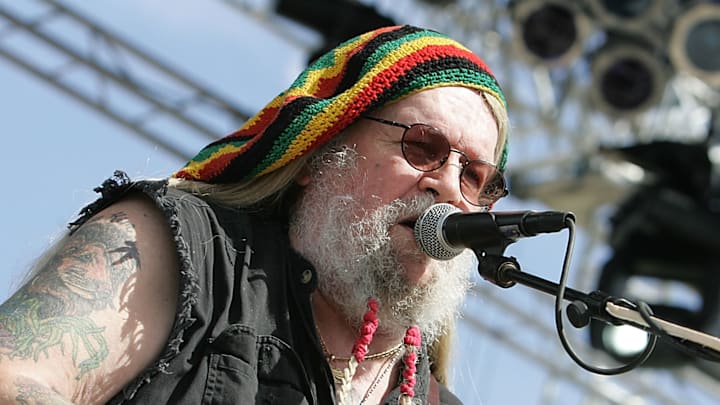
“Country DJs knows that I’m an outlaw…”
It was 1975, and outlaw country was a going concern. One of the core members of the club, David Allan Coe, had already released four albums – two on a major label – but had yet to really hit it big. His third album for Columbia, Longhaired Redneck, was supposed to change that. It didn’t.
It didn’t do poorly. It was fairly well-received. If you listen today, it stands up better than a lot of mid-‘70s country music, even from the hallowed outlaw movement.
But Coe, who died on Wednesday at the age of 86, never quite fit in the way an artist boasting his talent should have. I think a lot of the reason can be found in the lyric above. It was the opening line from the opening song on Longhaired Redneck. The song was also called “Longhaired Redneck.”
David Allan Coe, a seminal figure in outlaw country, dies at 86
Coe is a tricky character in the country music landscape. He was both loved and reviled, often for the same traits. I promise to explain the link between the lyric and the man shortly, but just in case you need a few basic facts.
Coe was born in Ohio. That very fact set him apart from the original outlaws. They were all Texans, except Johnny Cash, who grew up about 100 miles away in Arkansas. He spent a lot of his youth in detention facilities before traveling to Nashville to try his luck as a songwriter.
Fortunately, he was just about as good as anyone in Music City at the time, and he enjoyed enough success writing for others that he was able to launch his own performing career.
The fact that his biggest early success came writing songs for others – Tanya Tucker’s “Would You Lay With Me (in a Field of Stone)” and Johnny Paycheck’s massive FU to all the world’s bosses “Take This Job and Shove It” – led to the mistaken impression that Coe was not a gifted singer in his own right.
He put that misunderstanding to rest by recording several strong songs written by others, such as John Prine and Steve Goodman’s “You Never Even Called Me by My Name” and his harrowing take on Gary Gentry and John Blayne Detterline Jr’s Hank Williams’ tribute “The Ride.”
He played alongside all of the outlaws, opening for them on the road and singing background on their albums. And he pumped out album after album of his special blend of rock-inspired outlaw country.
Coe was far from a one-trick pony. He could get down and dirty like on “Need a Little Time Off for Bad Behavior” or downright country-sentimental in “Tanya Montana” from the same 1987 album. He had a wicked sense of humor – one that could get him in trouble – and a soft, mushy heart that at times teetered on the precious. At other times, it could result in gut-wrenching tunes.
Coe pissed off a lot of people over the years. He said racist and misogynistic things and tried to brush them off as jokes. Maybe they were. It was the 1970s, and a lot of respected artists said a lot of things that wouldn’t pass today. (I still marvel that Jimmy Buffett sang “Fifteen may get you twenty, but that’s all right,” and we all just laughed it off.)
But there was something else about Coe that went beyond crude jokes. Back to that opening line from “Longhaired Redneck.”
“Country DJs knows that I’m an outlaw…”
Real outlaws didn’t feel the need to declare it. And they sure didn’t feel the need to intentionally mangle grammar on a word like “knows” to hammer home the point. This was 1975, and three years later, Waylon Jennings would make the position of the OGs crystal clear with “Don’t You Think This Outlaw Bit’s Done Got Out of Hand?”
Later in “Longhaired Redneck,” Coe sings, “They tell me that I look like Merle Haggard.” But you can’t avoid one fundamental difference between the two very similar artists. Early on, Haggard went out of his way to hide his law-breaking past. He didn’t want people to know that he had served time.
Eventually, the likes of Johnny Cash would convince him that to be his most authentic self, he would have to own his past. When he did, Haggard conveyed understanding but not pride.
Coe, on the other hand, exaggerated his lawlessness. He wanted to be known as a bad-ass…. another line from “Longhaired Redneck” boasts “I won every fight I ever fought.”
David Allan Coe had plenty of fans who loved his talent and who told stories about how kind he was in personal meetings. The fact that there are a bunch of counter-narratives about the less positive sides of his personality shouldn’t shock anyone.
Plenty of people had problems with Kristofferson (too politically woke), Waylon (very belligerent in certain circles), and Cash (an admitted devil when under the influence). That’s nothing new. (Everyone loved Willie – and still does to this day).
But the sense of overly-aggressive self-promotion led some to question Coe’s authenticity, and that charge, even if unfounded or blown all out of proportion, is tough to live down. It takes a certain amount of chutzpah to write a song called “Willie, Waylon, and Me.”
This remembrance is more negative than I intended, and that says more about me than about David Allan Coe. The fact is, I really enjoyed Coe’s music. I think he was among the best songwriters in a very competitive arena, as well as a damned good singer.
You can read Mickey Hayes’ highly entertaining memoir My Life on the Road with David Allan Coe for a barrelful of stories about the singer back in the late ‘70s and early ‘80s, and you will come away with an image of a wild and mostly decent man who poured himself into his music.
I suspect that I am simply trying – as others have before me – to figure out why DAC wasn’t bigger. I ask the same questions about other elite three-name songwriters like Jerry Jeff and Ray Wylie. (Walker and Hubbard, if you don’t already know.)
Coe was a wild man, but looking back, it may be that his sentimental side was what kept him from a bigger solo career. Back to that song “Tanya Montana” for a moment. It was from Coe’s 1987 album A Matter of Life … and Death. It was written for his newborn daughter, now a country singer herself. It is a beautiful song from the land of old school country.
Now listen to that song alongside two identically themed numbers from the same era. Steve Earle recorded “Little Rock ‘n’ Roller” for his son Justin in 1986. John Hiatt released “Georgia Rae” for his daughter in 1988.
Neither of those songs is better than Coe’s, but they sound more contemporary, at least to my ears. Even Earle’s lullaby, which is just as soft and sweet, has more of a contemporary edge than Coe’s throwback.
Both the younger Coe and Earle went on to careers in music. Georgia Rae Hiatt, to the best of my knowledge, did not, though her older sister Lilly has carved out a nice career in country and rock.
David Allan Coe was a generation older than John Hiatt and Steve Earle. He was a contemporary of the four primary outlaws, but a few years younger. I sometimes wonder if he simply had bad timing, and that, more than an at-times off-putting personality, is what kept him from rising to the level that his talent merited. It may be that David Allan Coe was just born just a few minutes too late.
Or maybe he tried a little too hard, or his mouth got him into trouble. In the end, it was probably bits and pieces or all of the above, and then some.
But as invariably happens when an artist disappears for good, most of that fades into the background. David Allan Coe left us with a ton of great tunes, and that’s a better legacy than most of us will ever have.
 Add us as a preferred source on Google