

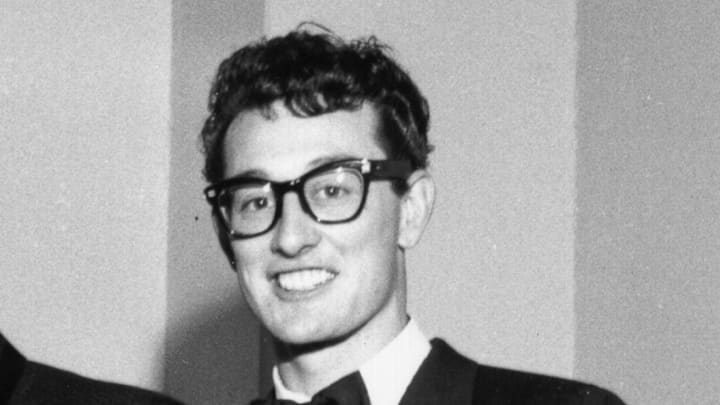
From Billboard’s number three song of 1972, Don McLean’s “American Pie”:
“And as the flames climbed high into the night
To light the sacrificial rite
I saw Satan laughing with delight
The day the music died.”
In McLean’s mythic fable about the death and birth of rock & roll music, there has always been debate as to the identity of Satan. Common wisdom says Mick Jagger, but I have seen cases made for others.
No one debates to whom he is referring when he sings “the music.” It was Buddy Holly.
Holly died on February 3, 1959, in a small plane crash near Clear Lake, Iowa. He was 22. The world had barely gotten to know the innovative genius from Lubbock, Texas, when he was taken away. His death has always left the haunting question of what might have been.
Buddy Holly’s final recordings
I'm writing this on January 22, and thoughts like that can be especially acute on a day like today. January 22 is an anniversary.
67 years ago, on January 22, 1959, Buddy Holly recorded his final songs in his New York City apartment near Washington Square. There were six new songs in all. Like Bruce Springsteen in the now-well-documented Nebraska sessions, Holly was alone, accompanying himself on guitar.
But the songs were not dire, like Bruce’s. They did speak of heartbreak and learning to roll with life’s punches, but Holly's voice was young and full of life.
The next day, he set out on a tour labeled the Winter Dance Party. In the early morning hours of February 3, Buddy Holly, Ritchie Valens, J.P. Richardson (AKA the Big Bopper), and pilot Roger Peterson were killed when their Beechcraft Bonanza crashed shortly after takeoff.
Those final recordings – all of which were subsequently released and which can be heard on Not Fade Away: The Complete Studio Recordings and More – suggest an artist who was not about to slow down. One of the songs even hints tantalizingly at one more fascinating “what might have been.”
These are Buddy Holly’s final six recorded songs.
“Peggy Sue Got Married”
The best-known of his final songs would have been remarkably poignant even if Holly had lived sixty more years. The fact of his death launched it into legendary status. He was 22 and yet he was still successful enough to have a sequel to one of his earlier hits – “Peggy Sue.”
Think of the maturity involved in the conception. “Peggy Sue” had been a ground-breaking love song. Now, a year later, the young singer completes the story. And it is somber and wistful and full of the heartache of wasted opportunity.
The girl of his dream has gotten married … although in a glimmer of hopeful desperation, he acknowledges “of course, the story could be wrong.”
Musically, Holly is deceptively simple, blending his jagged shuffle with an occasional seventh chord in the middle of the verse, which creates a slightly more tenuous melodic line than the buoyant “Peggy Sue.” It’s a beautiful depiction of disbelief in loss – with a message that would resonate in the wake of tragedy. Of course, the story could be wrong – that became the wish of every music lover on the morning of February 3, 1959.
“Crying, Waiting, Hoping”
Similar to “Peggy Sue Got Married” but with a peppier beat. Though it also expresses the sadness of a missing love, it is not as definitive as “Peggy Sue…” There is still hope. “Maybe someday soon things will change, and you’ll be mine.” Holly even throws in an echo of that yelp – or yodel – that belies his roots as a rockabilly singer from Texas.
“What To Do?”
“What to do now that she doesn’t want me?” That’s the opening line, and you can probably guess where the song goes from here. This is one of those songs that hint at the maturing artist. The writing is more evocative as he explores memory, and Holly’s voice was never as warm and sweet.
“That’s What They Say”
A lilting tune about the promise of love. As keeping with the subject matter of these final numbers, he is lamenting that this promise has yet to be fulfilled. Though the chorus mimics “Peggy Sue Got Married” a bit, the inclusion of C#7 chord in the middle of the first verse creates a tension that isn’t always present in some of his earlier songs.
Holly wasn’t reinventing the wheel by any means, but he was poking and prodding at the sounds and structures of his first hits, and creating a more dynamic melodic range to carry his songs of love and longing.
“Learning the Game”
Listen – not every song is going to be a gem. Of Holly’s final six recordings, five of them are well worth a listen, and a couple are truly beautiful. “Learning the Game” is not one of them. There’s nothing particularly wrong with it, and perhaps he would have continued playing with it if he had the chance. But it is the least successful of the final six.
“That Makes It Tough”
“Peggy Sue Got Married” is the best-known song from this group. But this one is the most fascinating. Context is crucial here. In 1959, traditional country music was in crisis. Rock and roll was cleaning its clock. Artists who may have leaned country based on their upbringing – artists like Holly himself – were accommodating the new, younger musical tastes by moving toward rockabilly.
But country music was about to come roaring back with several crucial developments. The most important was the codification of the Nashville Sound, or Countrypolitan music, which smoothed out the rough edges of old-timey music and dressed it up for mass popular appeal. It worked, though many lamented the eventual results.
Buddy Holly could have been a country singer. Had he been born several decades earlier, he might have been Jimmie Rodgers. “That Makes It Tough” offers a glimpse into the way that Holly might have helped evolve country had he lived.
It’s far more raw than the Nashville Sound would have allowed, but it manages to apply a modern sensibility to a very old song styling. His vocals and his quiet strumming pack a lot of emotion into a pretty simple 135 seconds.
Had he lived, there’s no doubt that Buddy Holly would have learned from the British invasion. He would have drawn from Ray Charles. And there’s also no doubt he would continue to affect those artists. Rock would have been different. Country would have been different. Maybe not radically different, but enough so that we would have noticed.
That’s what I hear in those final songs. Of course, my story might be wrong.
 Add us as a preferred source on Google