

If I’ve learned anything in my many decades on this planet, it’s that discussions about politics and religion may turn toxic pretty fast, but nothing gets the vitriol a-flowin' like asking a bunch of music fans to name the greatest guitarists of all time. The BBC’s Steve Wright nonetheless tried a few days ago. He cut off his list at 31.
That prompted my Audiophix colleague StevieMac to respond with five classic rockers who perhaps should have been on Wright’s list. Both writers’ choices are entirely defensible. I was wondering about at least three of the omitted players StevieMac brought up.
It got me thinking about so many names and riffs and solos that I decided to join StevieMac and add my own selections. And to add my own little spin to the endeavor, I decided to split my guitarists into categories.
5 musicians who established the foundation of rock guitar
We’ll begin with the foundational players. I think it’s reasonable that Wright did not include anyone from the pre-rock era, but several seminal artists helped make the transition from the blues, folk, and gospel traditions that coalesced into rock & roll in the 1950s.
Here are five of the greatest.
Sister Rosetta Tharpe
Almost every list of all-time greats recognizes the way Sister Rosetta Tharpe elevated the guitar, helping pull it out of its role as a rhythmic instrument in a gospel ensemble and foregrounding it alongside the vocals. She was a truly transitional figure in rock’s infancy.
She took gospel music out of the church and brought it to the nightclub, proving that by nodding just a bit toward the secular, this music could broaden its appeal. Though never considered a rocker herself (her extra-gospel appeal stopped at R&B), she was still supremely influential on the new genre.
She helped make the electric guitar the alpha instrument in popular music after WWII, and her influence on virtually every major early performer in the rock gestational era has been attested to over and over. Chuck Berry, Little Richard, and Johnny Cash, who collectively represent much of the DNA of rock and roll, all cite Sister Rosetta.
Seminal tracks: “That’s All,” “Rock Me”
Merle Travis
Travis was a crucial songwriter and performer in the formative days of country music. He penned classics like “Sixteen Tons,” “Nine Pound Hammer,” and “Dark As a Dungeon.” Travis had hits with those songs, using his easy-going, conversational delivery. But there were better singers. Tennessee Ernie Ford delivered “Sixteen Tons” better than Travis could.
But no one in early country music could touch what Travis did with his guitar. He wasn't the first player to regularly employ complex finger picking patterns, but he took it further than anyone had to that point.
That’s why they named an entire style after him. His 1955 album The Merle Travis Guitar opened up new vistas for the electric guitar. 14 years later, Strictly Guitar proved that he wasn’t merely an early influence. He was simply one of the best.
Seminal tracks: “Blue Smoke,” “Cannon Ball Rag”
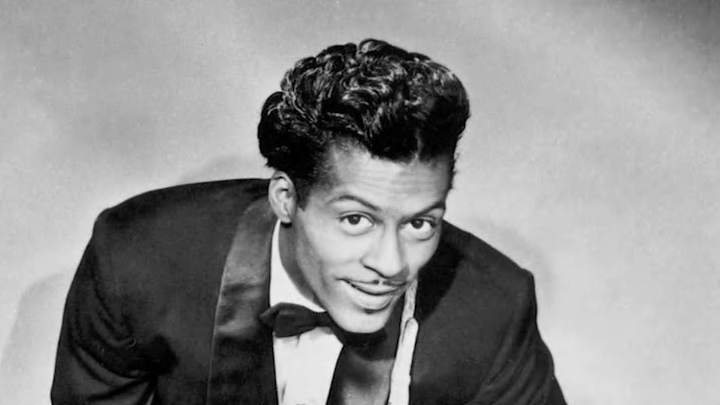
Chuck Berry
If Tharpe and Travis paved the way, it was Chuck Berry who showed how the electric guitar could be the bedrock on which a new genre of popular music could be built. The guitar-gods-to-come may have been faster and more inventive. You can certainly make the case that they were better guitar players. But none were as important. They all would stand on Chuck Berry’s shoulders.
Berry introduced the guitar riff as the most crucial musical element in a rock and roll song. He married gin joint velocity with roadhouse twang, and music would never be the same. The fact that he went so far as to write one of the foundational rock songs about the guitar and the guitarist only adds to his importance.
Seminal tracks: “Johnny B. Goode,” “Roll Over Beethoven”
Bo Diddley
There is a tendency to rate guitar players by their riffing and their solos. Speed and tone. Those are entirely fair barometers, and many of the players on Wright’s list and all of our follow-ups had amazing technical chops.
But if I expand this particular article to cover other styles and genres, we are going to get to some players whose primary contribution as a guitar player was more rhythmic than riff-based. Amongst early players, Bo Diddley was the king of rhythm. They named an essential rock rhythm pattern after him. The “Bo Diddley beat” has been at the core of many great rock and blues songs.
Seminal tracks: “Bo Diddley,” “Road Runner”
Scotty Moore
Scotty Moore was second only to Chuck Berry in creating the modern rock guitar sound. As Elvis Presley’s primary guitar player throughout the King’s heyday, Moore was as important in the evolution of rockabilly as any guitar player has ever been.
Moore married a propulsive rhythm with seamless solos that added a level of excitement when Elvis wasn’t driving the kids crazy with his voice. Elvis would strum a guitar, and plenty of other guests would wander in from time to time, but on most of Elvis’ hits, Scotty Moore is handling the bulk of the instrumental melodic elements.
Seminal tracks: “That’s All Right” (with Elvis), “Milk Cow Blues” (solo)
I’ve gotten to the end, wondering how I could leave out influences like Mother Maybelle Carter, jazz master Django Reinhardt, or the inventor of “Rumble,” Link Wray. Oh well, maybe I’ll have to write a few more of these.
 Add us as a preferred source on Google