

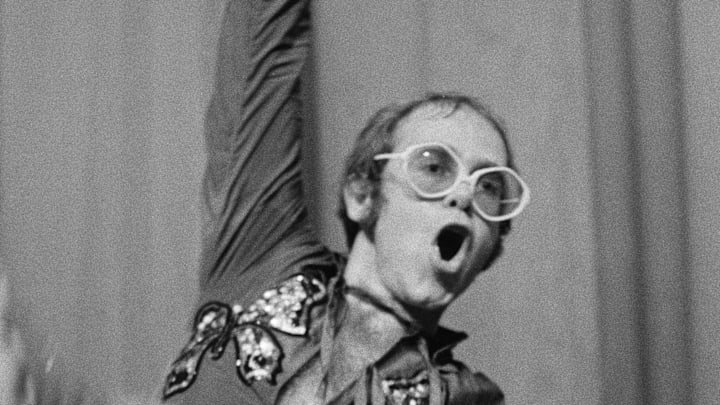
When he won an Emmy for his variety special Farewell from Dodger Stadium in 2023, Elton John claimed the rare status of an EGOT. The Emmy completed his cycle. He had already won a Tony Award in 2000 and had taken home two Oscars in 1994 and 2019. As for a Grammy…? Well, that was the very first box he checked.
The British pop legend earned his first Grammy nomination more than 50 years ago, in 1971. This year, he is nominated again for two more awards. They mark the 36th and 37th nominations of his distinguished career.
Back in 1971, he was one of the most exciting new voices on the pop scene. Before his 25th birthday, he had released his first two albums. The second – a self-titled sensation from 1970 with singer-songwriter classics like “Your Song” and “Border Song,” delivered his first three Grammy nominations for Best New Artist, Album of the Year, and the now-defunct Contemporary Male Vocalist.
Elton John is up for two Grammies, more than fifty years after his first nominations
John did not take home any trophies in 1971. In hindsight, he probably should have received the New Artist prize, though at the time, you could certainly make a case for the winning act – the sister/brother pop duo Carpenters.
They were massive in the early ‘70s. Sadly, vocalist Karen Carpenter’s demons would catch up with her, and she would die in 1983, depriving pop music of one of its greatest voices.
As for Elton John’s voice, that has never left us. Through ups and downs, partners, styles, and reinventions, he has remained a major force in the world of pop and rock music to this day.
He would have to bide his time through a dozen more nominations and 16 more years before winning his first statue. It came in 1987 in the awkwardly-titled category “Best Pop Performance by a Duo or a Group with Vocal.” The song was “That’s What Friends Are For,” a composition by Burt Bacharach and Carole Bayer Sager, which also claimed the Best Song prize that year.
John sang it with Dionne Warwick, Gladys Knight, and Stevie Wonder, and the proceeds from their record went to fund AIDS research.
Five years later, John claimed his second Grammy in the Instrumental Composition category. The music was titled "Basque," performed by James Galway on the flute.
He next won awards for Male Pop Vocal Performance in both 1995 and 1998. The first was for “Can You Feel the Love Tonight” from The Lion King. The second was for his reworking of the same song that had earned him a similar nomination a decade earlier.
In 1988, Elton was nominated for a live performance of his tribute to Marilyn Monroe – “Candle in the Wind.” Though he did not claim the prize that year (Sting won for “Bring on the Night”), he did win in 1997 when he rewrote the lyrics to honor Lady Diana in “Candle in the Wind 1997.”
His most recent Grammy came in 2001. Aida, the production that won him his Tony, also earned him a Grammy for the show album.
That adds up to five Grammys, plus a sixth special honor as a Grammy Legend in 1999, making a total of six Grammys and counting.
This year, he is nominated for his original song “Never Too Late,” composed with Brandi Carlile for the documentary movie Elton John: Never Too Late. He and Carlile are also up for Best Traditional Pop Vocal Album for Who Believes in Angels.
John has been nominated for each of the Big Four awards – Record, Album, Song, and New Artist – but has yet to win one. The most confounding aspect of his long Grammy history is not the fact that he never claimed one of those Big Four – it’s that his very best albums were never nominated.
Between Elton John (1970) and Caribou (1974), Elton released a staggering five original studio albums, which dominated the pop charts. Two hit number one. Two made it number two. The only “non-smash,” 1971’s Madman Across the Water, contains some of his most enduring music and is often ranked among his very best today.
No disrespect to the artists who did receive recognition in those years, but Elton should probably have had more nominations and perhaps another win or two for his remarkable work in the early 1970s.
 Add us as a preferred source on Google