

When thinking about the latest music documentary directed by Ahmir Khalib Thompson – AKA Questlove – it may be helpful to consider the subtitle.
In fact, it may be useful to look at how the subtitles have evolved over the course of his three primary feature documentaries. (He was also responsible for the very entertaining compilation film chronicling fifty years of music on Saturday Night Live, but that one did not have a subtitle.)
Though he had been involved in making music-themed docs for many years, his first time behind the camera came in 2021 with Summer of Soul (…or, When the Revolution Could Not Be Televised).
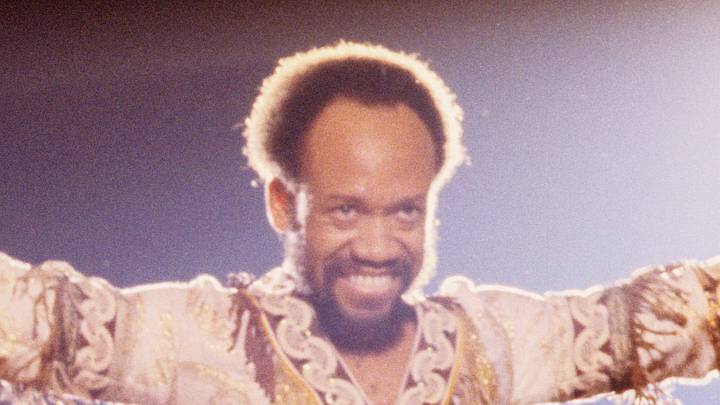
Questlove tackles the complicated life of Maurice White of Earth, Wind & Fire, in his latest movie
He won an Oscar for that one. He followed it last year with Sly Lives! (aka The Burden of Black Genius), a riveting portrait of the career of Sylvester Stewart … AKA Sly Stone. Now, he is back with Earth, Wind, & Fire (to be Celestial vs That’s the Weight of the World).
The unwieldiness of the latest subtitle may suggest a bit of contradiction in the focus. Despite documenting the history of the band, serving up a fine selection of music, and plenty of evidence of their significance, this is not really a movie about Earth, Wind & Fire. It is, first and foremost, a movie about the band’s founder, Maurice White.
That does not mean the members who made up Earth, Wind & Fire are not well represented. They are all over the movie. White died in 2016. He appears in many archival interview clips, so his voice is prominently featured.
Fortunately, much of the rest of the band is still with us and shares their memories of White and the 1970s, when the band became an international sensation with a new brand of eclectic dance music.
Those members include percussionist Ralph Johnson, vocalist Philip Bailey, and best of all, Verdine White, EWF’s sensational bass player and half-brother of Maurice.
They all get their moments, such as Verdine continuing to pound his bass while seeming to levitate horizontally in one of the band’s many spectacular stage effects, and Bailey ruining everyone’s favorite love song “Reasons” by explaining what the song really says. (This is a bit like the soul love song equivalent of “Born in the USA,” so skip that part if you want to maintain your illusions.)
Through it all, Maurice remains front and center. He is a worthy subject. An obsessive musical visionary who helped popularize the African kalimba – AKA thumb piano. He put it on top of a funky groove, added horns and soaring vocals, and for the second half of the 1970s created some of the most popular and most beautiful music in the world.
The band began knocking on the door with Head to the Sky (1973) and Open Our Eyes (1974). Then they blasted through that door in 1975 with the massive crossover hit, That’s the Way of the World. That project came about as a result of a proposed movie that quickly faded from view.
White and his band had been asked to provide the soundtrack. With the film project faltering, White and his co-producer and mentor Charles Stepney had the wherewithal to release a stand-alone album. It was a wise move.
That’s the Way of the World went to number one on the Billboard pop chart, as well as the R&B chart. It’s most successful single, “Shining Star,” accomplished the same feat. It also inspired Stevie Wonder to create “Sir Duke.”
Oh, did I mention that Wonder appears multiple times in the movie to talk about the impact that White and EWF had on his own music? Stevie Wonder! White also inspired Michael Jackson and Prince, though they are no longer with us to discuss that impact.
But Flea is. And H.E.R. Anderson .Paak. Lionel Richie and Jimmy Jam. They all show up to sing the praises of Maurice White. As do Barack and Michelle Obama.
Clearly, Maurice White was a special artist. But Questlove does not tag him with the “genius” label that formed the heart of his Sly Stone movie. In a way, White and Stone had similar stories. Roaring success built upon a large, inclusive “family” of musicians. A polymathic musical brilliance that fashioned divergent strands into something fresh and new and astonishing.
And similar collapses based on their obsessive need for control and the pressure of continuing to evolve as artists. White did not suffer the same types of addiction issues as Stone, but he still found it difficult to maintain the “family” into the 1980s.
Questlove has many of those closest to White – his longtime partner Marilyn, his eldest son KB (whose birth inspired the glorious song “September”), and his younger son Eden – as well as old friends, discuss the personal demons that led White to have serious abandonment issues throughout his life.
Questlove does not shy away from those messier parts of the story, but they never derail the main throughline. Just as many of the musicians who worked with him can express disappointment over certain chapters while still clearly cherishing what Maurice White gave to them and to the world.
If it isn’t quite as incisive or eye-opening as Summer of Soul or Sly Lives!, which may be because Earth, Wind & Fire was not quite as revolutionary as the first two subjects. But that surely does not mean they didn’t create sensational music and have plenty of great stories to tell.
Earth, Wind, and Fire (to be Celestial vs That’s the Weight of the World) is currently available to stream on HBO Max.
 Add us as a preferred source on Google