

As I write this, the number one song on the Billboard Hot 100 is “Choosin’ Texas” by Ella Langley. It has held the top spot for nine straight weeks and if it relinquishes its position in the next week or two, it will probably be because “Be Her” – also by Ella Langley – will have supplanted it.
Maybe you’ve heard “Choosin’ Texas.” It’s kind of the flip side of Megan Moroney’s “Tennessee Orange” about a Tennessee woman who loses her man to his home state and his ex. It begins…
“Just when I thought I got him to fall in love with Tennessee
I shoulda known better than to take him back to Abilene.”
Now, I can tell you what the song is about and how to identify it because Langley, like the overwhelming majority of the chart-topping Billboard artists before her, actually sings words in her song. Or, if you want to sound in-the-know, you can call them “lyrics.”
Billboard’s most successful instrumentals
“Choosin’ Texas” is the latest of 1,191 songs to claim the top spot on the Hot 100 since Billboard began its iconic chart in 1958. To be clear, they kept charts prior to 1958, but that is when the current system came into existence. It has morphed over the years as music consumption has changed, but that Hot 100 top spot remains precious territory.
Of those 1,191 number ones, 25 of them have been instrumentals. That’s about 2%. For some reason – or, more likely, reasons – the overwhelming majority came in two distinct five year periods.
In the charts earliest years – 1959-1963 – and then in the mid-1970s – 1973-1977 – 18 of those 25 songs hit number one. Only one instrumental has been number one since 1985.
Now, I am going to sidestep the tricky issue of what defines an instrumental. The 25 songs we will consider are canonical. Many are indeed pure instrumentals. Some have vocalization but no actual lyrics. Others do indeed have words. Just not very many. They usually provide a brief rhythmic chorus, and, unless you are real purist, don’t violate the definition of instrumental to most ears. We may discuss this further on a case by case basis.
Then again, maybe not.
The mission today is to rank those 25 songs, from worst to best. As always, this is just one man’s opinion. I apologize in advance if that opinion does not align with your own. Feel free to contact me with your own list.
25. “Calcutta” by Lawrence Welk and his Orchestra (1960)
This is an entirely innocuous song that has nothing whatsoever to do with the Indian city. I might have seen my way toward elevating it above the bottom rung if it were just bland strings and accordion. But there are indeed vocalists, chirping the melody line with something that sounds like “la, la, la, la.” And when the higher-pitched female vocalists join in, this goes from being merely innocuous to be outright irritating.
24. “Theme from A Summer Place” by Percy Faith and his Orchestra (1960)
This was the first of the movie/television themes to hit the top spot. There would be several more. It’s a breezy, boring piece with violins carrying most of the load, with some repetition coming from the woodwinds. Max Steiner’s music, like the movie itself, is pleasant enough. It was actually considered a bit risqué at the time. That is not the case today.
One note – this song was number one for nine consecutive weeks in 1960. That set the record for most consecutive weeks for any song – instrumental or otherwise. It took ten years and the Beatles to surpass that mark. It is, by some measurements, the most successful pop instrumental ever recorded.
23. “Star Wars Theme/Cantina Band” by Meco (1977)
This is not the version from the hit movie, but rather a medley of the two popular John Williams melodies stitched together in disco fashion by pop music producer/arranger Meco, (AKA Domenico Monardo.) It gets the splashy, futuristic sci-fi treatment that seemed dated almost as soon as it hit the airwaves, and the “Cantina” second half is downright silly. But the movie was so popular that people loved it for a few moments before they never wanted to hear it again.
22. “Wonderland by Night” by Bert Kaempfert and his Orchestra (1960)
I do wish I could go higher with this one. After all, as all Barenaked Lady fans can attest, “Bert Kaempfert’s got the mad hits.” Sadly, this one, despite some nice little muted horn, is just kind of sleepy.
21. “The Hustle” by Van McCoy and the Soul City Symphony (1975)
This was a cultural phenomenon in the early days of disco’s ascendency. It provided a unifying message – “Do the Hustle” – and the dance to go along with it. If you listen now, you realize that the music isn’t all that interesting, and without the vocalized parts – the expressive, melodic “oohs,” and the aggressive “Do its” and “Do the Hustle,” there really is very little exciting about this song. Therefore, I downgrade for being overly reliant on actual vocals. Plus, I don’t think it’s all that good.
20. “Stranger on the Shore” by Mr. Acker Bilk (1962)
Acker Bilk was one of the most unlikely Billboard chart-toppers. As a jazz clarinet player and singer, he played a somewhat hipper brand of easy listening than you might get from Bert Kaempfert or Herb Alpert. “Stranger on the Shore” has a vaguely Hawaiian vibe that makes the “shore” part not unreasonable. It is not particularly memorable, but not such a bad tune to play on a breezy day lounging on the beach.
19. “The Stripper” by David Rose and his Orchestra (1962)
A pure novelty song, but one that hit its target perfectly. The big trombone sound became synonymous with its titular profession. At barely two minutes long, Rose knows full well not to overstay his welcome.
18. “Harlem Shake” by Baauer (2013)
There had not been an instrumental reach the top of the Hot 100 for 28 years when Harry Bauer Rodrigues – AKA Baauer – achieved his greatest individual success. Baauer was just 23, but had been experimenting with mixing dance music from his early teens.
The song is an undeniable dance banger and spread like wildfire via YouTubers posting their own moves. It reached number one based on streams alone. It does sample plenty of vocalizations but I suppose it is still rightly considered an instrumental. Its music is certainly more substantial than “The Hustle.” Still, after a strong beginning, I think it kind of runs out of inspiration about halfway through its 200 seconds and grows a wee bit tiresome by the end.
17. “Love’s Theme” by Love Unlimited Orchestra (1974)
“Love’s Theme” was more significant than it was good. That doesn’t mean it wasn’t a sweetly pleasant romp with a nice central theme and enough funky touches to make it a good dance tune. But historically, as one of the key songs that kicked off the run of soul/disco instrumentals that would help drive the disco explosion, it punched above its weight. And as one of the tunes that helped reintroduce veteran Barry White to the world of lovers, it remains indelible.
16. “Fly, Robin, Fly” by Silver Connection (1975)
OK, I’m going to admit a bias here. By rights, this song should probably rank a bit higher. Maybe not a lot, but a few spots. The funky little bass that opens it up, soon joined by drums and piano could almost be lightweight Sly. Then the vocals kick in. It’s only eight words – “Fly, robin, fly – up, up to the sky” – but it is repeated throughout. It is a vital part of the song.
And those are indeed lyrics, not merely sounds. So I question whether this should really be considered an instrumental, though I may be the only one who does. The fact is, the song is pretty cool without the voices, so it deserves credit. But those voices – those simple lyrics – do bring a lot to the party.
15. “Gonna Fly Now” by Bill Conti (1977)
Speaking of flying … the theme from Rocky functioned very well in the movie. Those portentous trumpets .. even the swirling harps. It is a rousing number. There’s some cool rock guitar in the middle. The song builds nicely. But let me once again just mention that while Bill Conti was credited for writing the music, Ayn Robbins and Carol Connors were credited with writing the lyrics. That’s correct. This instrumental has credited lyricists. I don’t think those vocals are essential in the way that “Fly robin fly” is to the previous entry, so it gets ranked slightly higher. On the other hand, I'm not sure that this is nearly as good when divorced from its movie. That is to say, if you put this piece of music on with no knowledge of Rocky, you may not be all that moved.
14. “Sleep Walk” by Santo & Johnny (1959)
The Farino brothers played some cool early surf rock and this expressive composition emphasized tone and mood far more than the energetic high-speed numbers that would come to define the pre-British invasion movement. Santo’s steel guitar said quite a bit with some fairly simple riffs.
13. “Love Theme from Romeo & Juliet” by Henry Mancini and his Orchestra (1969)
Franco Zeffirelli’s lush take on the bard's classic was famous for actually casting teenagers in the lead roles. It was a roaring success, winning a couple Oscars and securing nominations for best picture and director. Mancini’s instrumental version of Nino Rota’s lovely music captures that lushness. It’s just over two minutes long and even so, it may grow tiresome by the end, but most of it works quite well.
12. “Rise” by Herb Alpert (1979)
I love the way Herb Alpert’s “Rise” begins. It starts off as a lo-cal Stevie Wonder song – lighter on the funk, heavier on the jazz. But even in its shorter single cut (the album version runs almost eight minutes) I think it get just a little lazy and doesn’t sustain its inventiveness all the way through.
11. “Chariots of Fire” by Vangelis (1982)
I think you could level the same charge against the tune that I used against the Rocky theme. Divorced from the movie Chariots of Fire, this composition may not carry quite the same heft. But I think as a stand-alone piece of music, it is still more interesting from start to finish. It combines modern electronic orchestration with a more classical aesthetic. And speaking of which …
10. “A Fifth of Beethoven” by Walter Murphy & the Big Apple Band (1976)
Murphy had the million dollar idea to use those famous four notes from Beethoven’s Fifth Symphony as the foundation of a modern dance number, surrounded by swirling synths, punchy horns, and some funkified electric guitars. Maybe it shouldn’t have worked. But it did.
9. “The Happy Organ” by Dave “Baby’ Cortez (1959)
The first instrumental to top the Hot 100, Cortez got there less than a year after the new system was implemented. A very spry and jazzy swirling tune gets bonus points for a wholly unexpected blast of electric guitar just over halfway through its tight two minutes.
8. “Love is Blue” by Paul Mauriat and his Orchestra (1968)
When French bandleader Paul Mauriat recorded a cover of Andre Popp’s “Love is Blue,” no instrumental had claimed number one on the Hot 100 for more than five years. Mauriat, despite relying on a 500 hundred-year old instrument to play a major role, somehow gave the piece a breezy modern feel. It remains one of the best uses of a harpsichord in modern popular music.
7. “Miami Vice Theme” by Jan Hammer (1986)
The heavily percussive theme to the coolest of 1980’s cop dramas features a grungy, fuzzy melody line that isn’t especially memorable. But those drums do some very heavy lfiting, at times sounding like gunfire, while at other times sounding like the oncoming apocalypse.
6. “Theme From S.W.A.T.” by Rhythm Heritage (1976)
A different television crime drama, this edges out Miami Vice based on its unforgettable melodic motif. It also has those pulsing drums which are not as tribal as MV, but the total package works just a tiny bit better. Spoiler – this is not the last TV theme song on the countdown.
5. “Telstar” by the Tornadoes (1962)
The Tornadoes were a British session band comprised of first-rate players who appeared on many recordings throughout the ‘60s. This composition was written by their founder, producer Joe Meek, who was an early proponent of space-age sounds in modern pop. It is an extremely cool piece of music that sounds like the theme from an old western being made by Martians.
4. “The Sound of Philadelphia” by MFSB (1974)
Commonly referred to as “TSOP,” this was created by Philly legends Kenneth Gamble and Leon Huff, among the most creative and prolific songwriting/production teams in pop music history. Soul Train creator Don Cornelius had the pair write the track as the show’s new theme song. There is some minimal singing toward the end courtesy of Philly vocal trio the Three Degrees but it is a minor addition. The music is sublime.
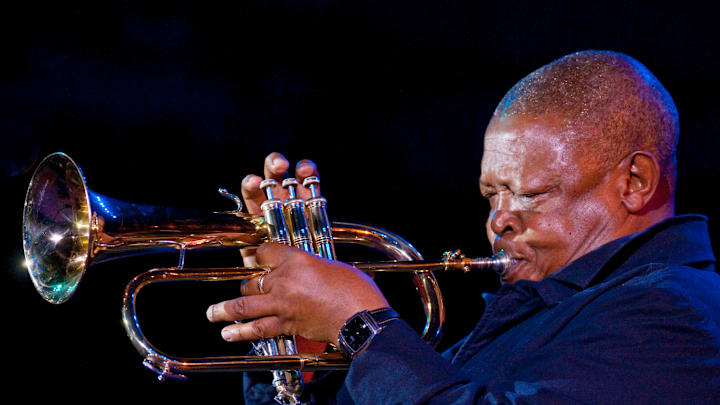
3. “Grazing in the Grass” by Hugh Masekela (1968)
The fact that the writer of “Soweto Blues” scored his greatest success with a jazzy instrumental number that later had fairly silly words added is one of those oddities of pop music. But it isn’t exactly analogous to Chuck Berry having his only number one hit with “My Ding-a-Ling.” That song is a childish joke. “Grazing in the Grass” is a joy.
The blend of staccato percussion with Masekela’s ultra-smooth trumpet creates dramatic tension that he then builds on over the brisk two-and-a-half minutes. The following year, the vocal quartet Friends of Distinction added lyrics (written by Friends founder Harry Elston) and took their version to number three.
2. “Pick Up the Pieces” by Average White Band (1975)
The fact that a white sextet from Scotland scored big with an exploration of American soul music struck some as a blatant case of cultural appropriation in 1974/’75. The fact that they did it so well, creating fine versions of the Isley Brothers alongside a number of originals, turned their second studio album into a number one hit. “Pick Up the Pieces” was the centerpiece. Skittery guitar and drums provide the foundation for Molly Duncan’s sax to carry the song and deliver one of the great sax solos of the ‘70s.
1. “Frankenstein” by Edgar Winter Group (1973)
My biases are obviously showing here. This is far and away the most rock-dominant instrumental to ever claim the top spot and I clearly like rock & roll. But it also the most explosive and inventive track on this list. Winter’s synth and electric piano are the dominant voices, but he also adds in some alto sax and has Ronnie Montose wailing on guitar.
Chuck Ruff gets a drum solo in the middle as the song builds to its spacy, machine-gun finale. In an era of highly inventive, cross-genre instrumentals including Focus’ “Hocus Pocus” and “Vas Dis” by Wishbone Ash, “Frankenstein” was the one that most successfully captured the public’s attention.
 Add us as a preferred source on Google