

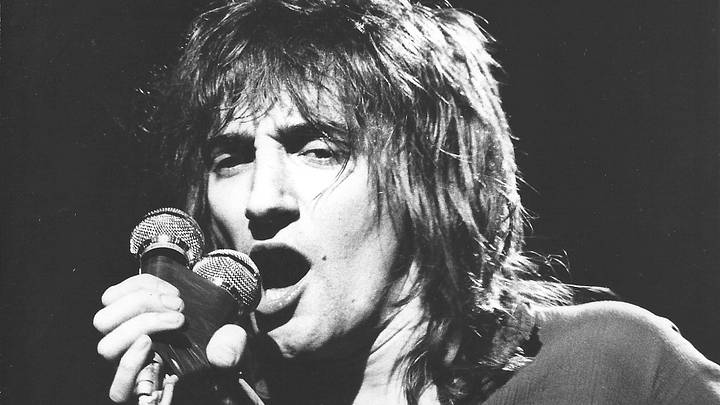
From his earliest days on the music scene, when he was doing battle with Jeff Beck’s titanic guitar runs, Rod Stewart has had one of the most distinctive voices in rock and roll. He developed that voice – not merely the gravel-throated tone, but the actual “voice” – in a couple of albums with the Faces and then through a long run of solo albums and one-off collaborations that kept him on the charts for decades.
Stewart recently announced his “Final Encore Tour,” slated for next year. It is being described as his last large-scale tour, which I suppose leaves the door open for smaller appearances. He is now 81 and had to cancel part of his most recent tour due to health problems.
Stewart’s most recent studio album came out in 2024. It went to Number 1 in the UK, a feat achieved by three of his last five releases. Rod Stewart has changed quite a bit over the years, but he remains an icon. I thought this might be a good time to count down his greatest singles – no small feat when considering such a long and eclectic career.
Rod Stewart’s 20 greatest vocal performances
As a solo artist, Rod Stewart has released almost 150 singles. Throw in brilliant work with the Jeff Beck Group and Faces, along with countless first-rate deep album cuts, and you are talking about an awful lot of great music.
In other words, this one was not easy.
For such a seemingly decent guy, Rod Stewart has a fairly divisive rep amongst rock fans. Few doubt his place in the pantheon of vocalists, but there are things that rub some people the wrong way. That voice – I know music fans who have to turn off his songs when they pop up on the radio due to some “nails on a chalkboard” visceral reaction.
Then there are the wild swings in genre. Going from early hard blues rock to more dance-flavored tracks in the disco era to, most amazingly, a major interpreter of the great American songbook, Stewart can appear, to those of a cynical mindset, to be something of a sell-out.
I reject that notion wholeheartedly. I consider Rod Stewart to be a restless artist who moved in directions that inspired him. I will warn you up front that some of his most popular late-‘70s dance floor hits will not be showing up on the following list. I can die happy never hearing “Hot Legs” again.
And you will find plenty of sentimental songs on this countdown, but again, some of them will be no-shows. There’s a fine line between Saturday night and Sunday morning, or between a song that is pitched just right and one that tilts over the edge.
Maybe were I a bigger soccer fan, “You’re in My Heart” would be on this list. I know many people love it. As for “Tonight’s the Night,” some wings are best left unspread.
This brings me to my final introductory remark. This is my list. As such, it will feature many of my personal favorites. That doesn’t mean this is merely a list of one fan’s favs. I have tried to use some distance and perspective.
For instance, my favorite Rod Stewart song will be on this list, but it will not be Number 1 on this list. By the same token, there are a handful of songs that I personally prefer to some that will be here, but I can’t really make the case that they are “better.”
So what you will get is twenty outstanding songs based on, but not strictly reliant on, my personal tastes. Most are over fifty years old, deriving from the Jeff Beck Group, Faces, and his first four solo albums. Many are famous; some are more obscure. But I promise, if you are a rock fan, you will like – I mean, really like – pretty much all of them.
20. “Maggie May” (1971)
I seriously considered leaving Stewart’s best-known hit off this list. It’s not that I don’t like it. It’s a fine song from his breakthrough solo album Every Picture Tells a Story.
Stewart wrote it with guitarist Martin Quittenton (and with disputed contributions from Ray Jackson) about a young man learning his first bittersweet lesson about love. It is a fine representative of Stewart’s ability to mix rock balladry with British folk music and the importance of the mandolin in such endeavors.
“Maggie May,” which stayed at Number 1 in the USA for more than a month in the fall of 1971, and which finished first in a Rolling Stone poll of readers' favorite Stewart tracks, began life as a B-side to a song that will be showing up later on this list.
I realized that my impulse to omit it here had more to do with me considering it overrated than it being an unworthy song. Sometimes, really fine songs can still be overrated. 20 feels about right to me.
(BONUS – in case you want to know, the Faces’ “If I’m on the Late Side” is the song that “Maggie May” ended up replacing on this list.)
19. “Young Turks” (1981)
As previously mentioned, I am not a fan of Stewart’s biggest disco-era hits. That doesn’t mean he couldn’t produce first-rate synth-driven dance tunes in the late ‘70s and early ‘80s.
“Young Turks” is an infectious groove combining strong work from two of his current collaborators – Kevin Savigar providing the synthesizers while Jim Cregan dropped Mark Knopfler-style guitar runs into the margins. It hit Number 5 in the USA and 11 in the UK.
18. “Forever Young” (1988)
The aforementioned Savigar and Cregan co-wrote this slice of hope and optimism. But the real co-writer was Bob Dylan, whose song of the same name first appeared on Planet Waves fourteen years earlier. Though not identical, they were similar enough for Dylan to request – and be granted without argument – co-writing credits. It made it to Number 12 on Billboard.
I should note that one rock critic whom I respect quite a bit referred to this particular song as “pablum.” I can kinda sorta see where that comes from, but that requires a pretty big dose of curmudgeon-ness.
17. “Tom Traubert’s Blues (Waltzing Matilda) (1992/1993)
The reason there are two years listed is that Stewart initially put out the song on his Lead Vocalist compilation album in 1992, and then included a live version on Unplugged…and Seated a few years later. I prefer the studio version, which I think is perfectly modulated, but the live track is almost as good.
To Tom Waits fans, this version is OK but doesn’t touch Waits’ original. Few of us who were fans of Stewart early on could have foreseen a day would come when we would prefer his more melodious take on a song that was written and recorded by a singer with an even more gravel-heavy voice.
Stewart’s best-known Waits’ cover is probably “Downtown Train,” which will not be on this list. I prefer Waits’ version of that particular song by a pretty wide margin.
16. “Ooh La La” (1998)
This one requires some backstory, because in many ways, it wasn’t a Rod Stewart song. Stewart seemed to really enjoy moving from the Jeff Beck Group with his pal Ronnie Wood (the same Ronnie Wood who has been the Stones’ other guitarist for more than fifty years).
Playing with the Ronnies – Wood and Ronnie Lane on bass – Stewart maintained his position with the Faces for about four years despite seeing his solo career hit the stratosphere. Lane wrote this song, which became the title track on the Faces' final album, and Wood sang it. Stewart was barely involved in the original recording in 1973.
25 years later, in tribute to Lane after his death, Stewart released his own version, and it is buoyant and beautiful.
15. “Pool Hall Richard” (1973)
“Pool Hall Richard” came in Faces waning days, released as a single after Ooh La La. Lane had left by this point. Stewart and Wood wrote it, hearkening back to their classic blues rock roots, complete with a brief juke joint piano riff from Faces keyboardist Ian McLagan.
It was technically the second-to-last single released by the Faces. I would tell you the final single, but its title is simply too long for me to type here.
14. “Lost Paraguayos” (1972)
“Lost Paraguayos” came out in 1972 and was co-written by Stewart and Ronnie Wood. But it is not a Faces song. Stewart was a major solo artist by this point, and this came from the follow-up to Every Picture Tells a Story. The new album was Never a Dull Moment.
The album hit Number 1 in the UK and Number 2 in the USA. As with “Maggie May,” this was a B-side. Unlike “Maggie May,” it remained a B-side, though it became a fan favorite deep cut.
13. “Plynth (Water Down the Drain) (1969)
Jeff Beck made a major splash with his debut album Truth in 1968. The follow-up, Beck-Ola, was a spottier affair. Beck always seemed on the verge of breaking wide without ever quite getting there. It may be that his guitar was just a bit too dominant.
That may be why some of the best singles from the Jeff Beck Group featured the rest of his band more prominently. “Plynth” was written by Stewart, Wood, and keyboard player extraordinaire Nicky Hopkins. It has a bit of twinkly music hall piano early, but then morphs into a heavy blues workout. All the while, Stewart’s vocals more than hold their own.
12. “Have I Told You Lately” (1991)
I am not including anything from Stewart’s more recent Songbook era on this list. That doesn’t mean I haven’t really enjoyed a lot of his later output. They are worth checking out, especially if you are a fan of American standards.
This song is not an American standard, but it did suggest back in the early ‘90s where Stewart’s career might one day be headed. This tender ballad was written and originally released by Van Morrison. It may be the only example I know of where I prefer a cover version to Morrison’s original.
Stewart strips the song down. The gravel is still in his voice, but there is a gentleness that serves the message beautifully. I think Morrison over-cranks both his orchestration and his vocals. Rod Stewart was rarely known for his restraint, but when appropriate, he could deliver achingly lovely vocals.
11. “Miss Judy’s Farm” (1971)
This blues burner kicked off the Faces’ album A Nod is as Good as a Wink … To a Blind Horse. It is raunchy and swampy, with the entire band at the top of their game. Another of the very fruitful Stewart/Wood songwriting collabs.
10. “I Was Only Joking” (1977)
Stewart’s solo album Foot Loose & Fancy Free begins with the major hit “Hot Legs” and closes with this sad lullaby penned by Stewart and Gary Grainger. That range captures the polar opposites contained in Rod Stewart.
From the tongue-in-cheek bawdiness of a fun-loving juvenile to the sad, heartfelt lament of someone who has seen a lot of life. As with “Forever Young,” I can understand why some listeners might not want to hear this soft a Rod Stewart. He even seems to turn a self-critical eye on this very impulse …
“’Cause what I’m doing must be wrong
Pouring my heart out in a song…”
And again, I find Stewart can pull this off better than virtually any other rocker who has ever tried.
9. “Cindy Incidentally” (1973)
Ian McLagan’s piano kicks off the Ooh La La track before the rock/blues groove kicks in. This was the first single from the final Faces album, and it was a great way to go out. McLagan got songwriting credit alongside Stewart and Wood on a song about the friendly breakup of a relationship. Was there ever a better swansong lyric than the closer of “Cindy…”
“Turn your music so loud, let’s attract a big crowd
We’ll drink a round to this town and bid goodbye.”
The Faces knew how to say farewell.
8. “I Ain’t Superstitious” (1968)
If you didn’t know who Rod Stewart was back in 1968, this would have been a very good introduction. Interpreting Willie Dixon while standing up to Jeff Beck’s wah wah guitar was no small feat for a vocalist. Stewart is up to the challenge on the closing track of the Jeff Beck Group’s debut album.
7. “I Know I’m Losing You" (1971)
Stewart recorded a track called “The Motown Song” with the Temptations on his Vagabond Heart in 1981. A decade earlier, Faces had done an actual Temptations song, written by Motown royalty Norman Whitfield, Eddie Holland, and Cornelius Grant. It features a tight blues groove while giving drummer Kenney Jones a chance to shine, and boasts some of Stewart's most anguished vocals.
6. “The Killing of Georgie, Pt. 1 & 2” (1976)
“The Killing of Georgie” was a sensation in 1976. Stewart said he based it on a true story of a gay friend who died as a result of a senseless act of violence. More than any other song in his long discography, “Georgie” shows off Stewart’s remarkable restraint in both writing and performance. His lyric …
“A leather kid, a switchblade knife
He did not intend to take his life
He just pushed his luck a little too far that night...”
is a model of how to deliver a devastating moment with supreme economy. And his voice – sweet, sad, non-judgmental, rough and weary – he captures it all.
5. “You Wear It Well” (1972)
A year after the triumph of “Maggie May,” Stewart teamed up with Martin Quittenton for a sequel of sorts. Again beginning with a simple acoustic pattern, this time Stewart tells the story of a lost romance.
The mandolin is replaced by a violin, making this more of a country song. But he resists any sense of the maudlin. It’s almost upbeat in its sense of maybe … just maybe … there is another chance coming.
4. “Handbags and Gladrags” (1969)
This is from the first solo album. He makes his rocking intentions clear right up front with a cover of the Stones' “Street Fighting Man.” But as always, he would explore other tones and styles. Mike D’Abo wrote it, and Chris Farlowe scored a minor hit in 1968.
Here, D’Abo plays the plaintive piano. This version, so powerful and so understated at the same time, is among the most poignant rock songs ever recorded. I mentioned at the beginning that my personal favorite Rod Stewart song would not be Number 1 on this list. Instead, it comes in at Number 4.
3. “Mandolin Wind” (1971)
Stewart wrote “Mandolin Wind” for Every Picture Tells a Story, and he got major support from Ray Jackson playing the actual mandolin. But this song stands out because of Stewart’s exceptional songwriting, which he interprets so beautifully in his vocals.
2. “Reason to Believe” (1971)
“Reason to Believe” had a remarkable history. It was the A-side of “Maggie May.” As you can guess from this ranking, I think it is a decidedly better song, but it was overshadowed. Still, it grew over time into an arguably bigger part of Stewart's repertoire.
The universal theme of forgiveness is layered alongside a swirl of piano, mandolin, and fiddle, all of which serve to make the break two-thirds of the way into the song all the more potent. The accompaniment drops out, and Stewart sings a cappella for a moment … perhaps the most memorable vocals he ever recorded.
1. “Stay With Me” (1971)
“You won’t need too much persuadin’
I don’t mean to sound degradin’
But with a face like that you got nothing to laugh about.”
In this recent run of sensational tender ballads, let’s not forget that Rod Stewart could belt out muscular – and, often amusingly juvenile – songs as well as anyone. “Stay With Me,” written with Wood for A Nod is as Good as a Wink…, is the ultimate. The band is on fire, and the exuberance of the vocalist is setting the tone.
Stewart’s current schedule has him kicking off his final tour in Georgia next March and hitting several southern cities before doing three months in the UK and Europe into the summer. He is slated to return for a couple of shows at Colorado’s iconic Red Rocks Amphitheater in September. Barring changes to the schedule, that may be the last time Rod Stewart plays a major venue.
 Add us as a preferred source on Google