

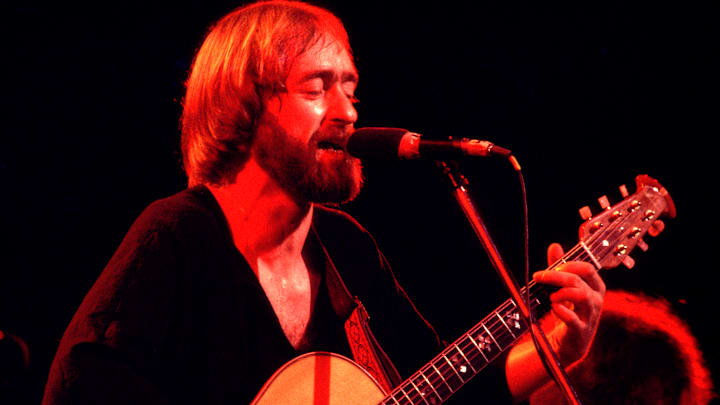
Dave Mason always felt like just a bit of an outlier in Traffic. If you go back and watch their induction into the Rock and Roll Hall of Fame back in 2004, Mason even looks and sounds different.
The drummer, Jim Capaldi, is there, and he does most of the talking. Primary frontman Steve Winwood makes a few closing remarks alongside the sister of deceased multi-instrumentalist Chris Wood. They all have distinct British accents. Mason does not, despite hailing from smack dab in the middle of the West Midlands.
And though they are all dressed in black, Mason is the only one also wearing a hat – a classic Texas cowboy hat, no less. Mason was British, but there was something American about him. He moved to the west coast of the USA in his early 20s and, despite changing addresses over the years, remained in the USA the rest of his life.
Founding member of Traffic, Dave Mason, dies at 79
Dave Mason died this past Sunday. Capaldi died a year after that RRHOF induction back in 2005. Winwood, the youngest and most famous member of the original band, is the only one now left.
Mason was not with the rest of the band very long. He was really only a full participant on the first two albums – 1967’s Mr. Fantasy and 1968’s eponymous album. Despite the success of several later records without Mason, a lot of fans today consider those two albums to be the band’s best work.
Mason was an integral part of the creative process in those early days. He wrote and sang four songs on the first disc, including the psychedelic standards “Hope I Never Find Me There” and the totally off-the-wall “Hole in My Shoe.”
Dave Matthews, who inducted the band during their RRHOF ceremony, remembered thinking as a kid that these guys were basically doing cool songs about cartoon characters. He doesn’t mention “Hole in My Shoe” by name, but that had to be one of the songs he was remembering.
Mason’s sitar flourishes on “Hole in My Shoe” – and even more so on the Capaldi/Winwood composition “Paper Sun” - added a major dose of psychedelia.
In hindsight, the difference between Mason and his bandmates seems to stem from Mason's devotion to more traditional song structures and melody lines. Capaldi, Winwood, and Wood were inherently more experimental. That does not mean Mason was not willing to try different things, or that the other Traffic artists ignored more traditional structure. But there was a split.
Mason would also contribute four songs for Traffic, diving a little more into blues rock. It began with the album’s lead track, the upbeat shuffle of “You Can All Join In,’ and the jazzy “Don’t Be Sad.” It hit its peak with “Feelin’ Alright,” one of the band’s biggest hits.
Mason’s interest in more pop-friendly songs led to his departure after Traffic. The lead track from the band’s third album, Last Exit, was also an older Mason song – “Just For You” – and it shows off that somewhat uneasy blend of pop and experimentation. Mason, who had briefly left the band after Mr. Fantasy, was gone for good by 1970.
Mason’s solo career burst out of the gates with his Alone Together album in 1970. The first track, “Only You Know and I Know,” hinted at a brilliant pop-rock songwriter about to burst out.
But his career never really took off. He certainly didn’t disappear. Mason maintained an active tour schedule up until the final years and occasionally put out new music for very appreciative fans.
After some fits and starts in the early ‘70s, it seemed that he had found a sweet spot in the world of softer pop-rock. 1977’s Let It Flow is an excellent example of that style of tuneful, quality songsmithing that might find big audiences. It featured his biggest solo hit, “We Just Disagree,” written by his friend Jim Kreuger.
But musical tastes were changing and Mason seemed old by the dawn of the 1980s.
Meanwhile, Traffic was a distant memory. Despite some dynamic music in the aftermath of Mason’s departure, the band began to drift without him. The psychedelic excursions, unmoored from Mason’s disciplined pop instincts, began to meander. It was already evident on 1971’s Low Spark of High Heeled Boys and it got more out of hand on subsequent releases. By 1974, Traffic was no more.
Winwood has had a very successful solo career. Mason didn’t do too badly himself. Capaldi continued writing his elevated lyrics on a series of solo and band projects. None of them vanished from the music world.
But Mason’s death does serve as a reminder that they were at their best when they were together. Mason may well have needed his bandmates’ restless experimentation just as much as they needed his pop acumen. Those first two Traffic albums are glories of the psychedelic age. You could easily make the argument that they were all at their very best between 1967 and 1969.
After that, it wasn’t to be. That’s sad, but it’s also part of art. Kreuger was not writing about Traffic when he penned the words that Mason would sing almost a decade later, but they seem to apply pretty well.
“So let’s leave it alone
‘Cause we can’t see eye to eye
There ain’t no good guy
There ain’t no bad guy
There’s only you and me and we just disagree”
 Add us as a preferred source on Google