

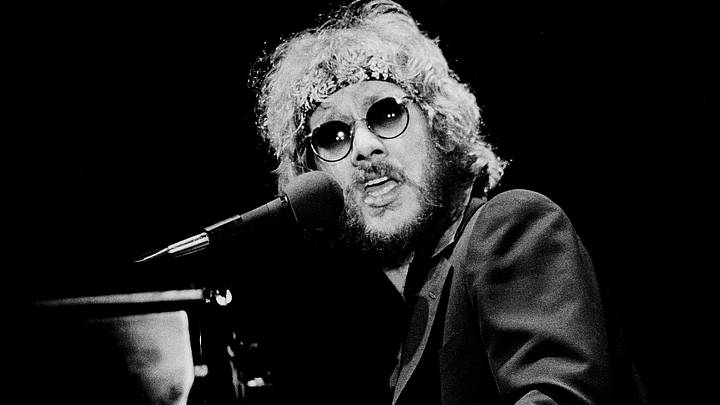
In 1993, The Larry Sanders Show aired an episode called “Off Camera.” For any fan of meta comedies about Hollywood, it is among the funniest and most incisive half hours of television you will ever see.
The sitcom starred Gary Shandling as Larry – a fictional late-night talk show host who had real celebrities playing themselves in outrageous send-ups of their lives and careers. Everyone who did that show had to have a genuine sense of humor about themselves. One of Larry’s guests that night was Warren Zevon.
Zevon didn’t appear until late, but he got one of the very best moments the show ever produced. It essentially served as the punchline to the episode and summed up the entertainment industry as well as any fictionalized moment I know of.
Warren Zevon’s self-titled gem turns 50 this year
Just prior to going on, Zevon chats with the show's producer (played by Rip Torn) and explains that he is sick and tired of performing his best-known song, “Werewolves of London.” The producer – ever the problem-solver – suggests a different song and Zevon happily agrees.
Backstage turmoil leads to extra time needing to be filled, and Larry casually requests that Warren do “Werewolves.” Warren grits his teeth and begins one of the angriest versions of a hit song you will ever hear.
The song that Zevon played before being coerced into “Werewolves” was “The French Inhaler,” (though Torn’s producer initially identifies if as “The French Connection.”) It is a baroque, piano-based tune with multiple musical flourishes and lyrics that bounce between the trenchant and the obscure. That describes most of Zevon’s best work.
And much of that best work appears on Warren Zevon, the singer-songwriter’s second album, in 1976. “The French Inhaler” was one of those tunes. In addition to Zevon’s ever-present piano, it has piercing guitar work from session icon Waddy Wachtel and full-scale orchestral strings courtesy of Sid Sharp, who a decade earlier had brought the violin to Brian Wilson’s legendary Pet Sounds album.
The song also features prominent harmonizing vocals from Don Henley and Glenn Frey. That last point is a fascinating little touchstone in rock and roll history because Zevon was often lumped together with the band that Henley and Frey fronted … the Eagles.
The Eagles had all the hits – among the most popular bands of the era. Zevon, on the other hand, was the sardonic genius who wrote spectacularly literate, musically complex pop songs that wowed critics. But with the exception of “Werewolves,” he never had a major hit.
Warren Zevon was not his debut, as is sometimes reported. He had released a self-produced album in 1970 called Wanted Dead or Alive, which quickly faded from view. In the wake of that disappointment, Zevon began a productive period as band leader for the Everly Brothers, who would serve as major inspiration for his later career.
It was there he first found Wachtel’s signature guitar sound. When the Everlys broke up, Zevon found himself performing on the Balearic coast in Spain when a friend from LA encouraged him to come back to the States for another bite at stardom.
That friend was Jackson Browne, who would play on and produce Warren Zevon. He was far from alone. It seems as if a lot of people in SoCal knew of Zevon’s particular genius and were eager to be involved.
In addition to Henley and Frey, JD Souther, the unofficial Eagle, appeared on a couple of tracks. So did Phil Everly and Bonnie Raitt and Beach Boy Carl Wilson. Lindsay Buckingham and Stevie Nicks, about to take over the world with Fleetwood Mac’s Rumours, both appear.
As did a host of other behind-the-scenes virtuosos. If you were in LA in late ’75 and you played or sung, you wanted to be on Warren Zevon.
The album opens with Zevon’s piano. The song is “Frank and Jesse James.” After a plaintiff 20-second piano intro, the full band kicks in, and Zevon takes on our first journey.
“On a small Missouri town Back when the west was young
Back when the west was young
Two boys learned to rope and ride
And be handy with a gun.”
A lot of what you need to know about Warren Zevon – both the artist and the album – is contained in that opening track. His interest in history … perhaps revisionist history. His interest in outlaws.
This is a time when the entire outlaw country movement was in its infancy. Zevon was never really a country artist like Waylon and Willie, but in spirit, he had a lot of Texas in his soul, even if that soul was swathed in LA cool.
Frank and Jesse are seen as victims. They may have been prone to violence, but they were turned into killers by a country at war with itself. They used their natural skills to get by as best they could. And they are eventually hunted down and killed.
Both musically and thematically, “Frank and Jesse James” is a more subdued version of the song that would come second on Zevon’s next album, Excitable Boy. That song, “Roland the Headless Thompson Gunner,” takes the James brothers’ story and exaggerates into absurdist humor. That exaggeration runs throughout Excitable Boy. On Warren Zevon, he is more fine-tuned and contained.
That by no means suggests that the album lacks energy. As with most of Zevon’s best work, he easily shifts between ballad and rocker. “Mama Couldn’t Be Persuaded,” the second song.
Is an up-tempo rocker about another outlaw – the singer’s mother who ignored her family’s advice and married a gambling man. Jackson Browne and JD Souther provide soaring backing vocals, and somehow Wachtel’s rocking guitar blends David Lindley’s fiddle seamlessly.
I am not a fan against the third track, a gentle love song called “Backs Turned Looking Down the Path.” It has some nice acoustic guitar work from both Buckingham and Browne, but is otherwise nothing special.
But it sets up a sensational run of songs that make up the middle of the album. The first, an aching love song that drips with poetry, is called “Hasten Down the Wind.” Linda Ronstadt, in the process of becoming a late-‘70s megastar would cover that song and use it as the title of her Grammy winning 1976 album.
Ronstadt would end up covering three other songs from Warren Zevon over the next few years. She did “Carmelita” and “Poor Poor Pitiful Me” on Sweet Dreams (1977). And “Mohammed’s Radio” on 1978’s Living in the USA.
You can choose whether you prefer Zevon’s originals or Ronstadt’s covers. There is no question that she had a much better voice and could do things Zevon could not try. But there is something special about hearing these songs – the tender or the angry – in the songwriter’s own voice.
“Poor Poor Pitiful Me” is a perfect litmus test. Ronstadt can belt it out it hit notes Zevon doesn’t dare attempt. But the gruff, angry disgust – aimed in all directions, including inward – hits even harder in Zevon’s voice. Just as “Frank and Jesse” foreshadow “Roland,” “Poor Poor Pitiful Me” sets the stage for “Lawyers, Guns and Money” on Excitable Boy.
As for the rest, “Mohammed’s Radio” is another sublime piano ballad that effortlessly blends Buckingham and Nicks’ background vocal with Bobby Keys’ sax runs. “Carmelita” is an equally beautiful love song, made poignant by the drug-addicted narrator and some lovely flamenco guitar from David Lindley.
Between them. “I'll Sleep When I’m Dead” is just as the title suggests … an angry rocker with help from Jorge Calderon and some jug playing by Fritz Raymond. It finds the singer …
“Drinking heartbreak, motor oil and Bombay gin … I’ll sleep when I’m dead.”
“Join Me in L.A.” – a funky track with prominent vocal support from Stevie Nicks and Bonnie Raitt, opens with the in-your-face observation about Hollywood in the mid-‘70s…
“Well, the say this place is evil That ain’t why I s
That ain’t why I stay
‘Cause I found something that’ll never be nothing
And I found it in L.A.”
He never identified what it is that he found, but you might just hear it in the music.
Warren Zevon closes with the glorious “Desperados Under the Eaves,” which begins with Copeland-esque western bravado before slipping into another poetic piano ballad about life in LA. The first verse ends with lines that only an incisive, witty writer like Zevon could some up with …
“And if California slides into the ocean
Like the mystics and statistics say it will
I predict this motel will be standing
Until I pay my bill.”
Carl Wilson arranged the harmonies – featuring most of the voices that appeared earlier on the album – which may account for the vague Beach Boys aura. But really, this is all Zevon. A conglomeration of instruments and styles that defy generic pigeonholing. Intimate and grand, sarcastic and touching … all wrapped up in a pretty tune.
Warren Zevon didn’t provide the commercial breakout that Zevon and Browne hoped for, but that would come a couple years later with Excitable Boy. And “Werewolves of London.” The Larry Sanders episode was fifteen years later and he was still playing that song every night.
But what he really wanted to play was “The French Inhaler.”
 Add us as a preferred source on Google