

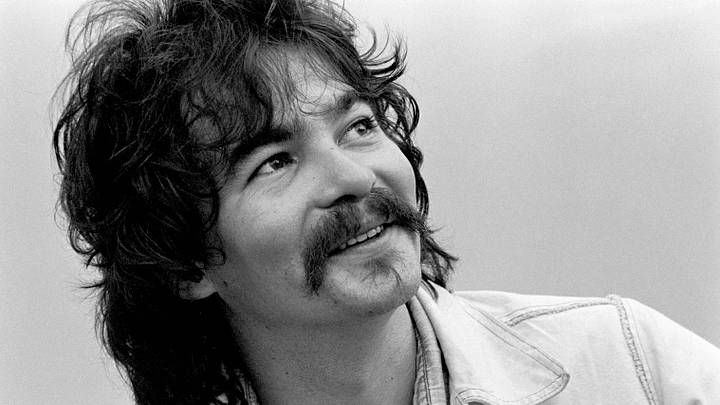
Anyone trying to put together a list of John Prine’s greatest songs runs into an immediate problem.
You have to start with his two best-known numbers – “Angel From Montgomery,” made famous by Bonnie Raitt, and the semi-autobiographical “Paradise,” Prine’s favorite concert closer, which was also covered by everyone from Johnny Cash and the Everly Brothers to John Fogerty and Sturgill Simpson.
You’d certainly want “Sam Stone” and “Hello in There,” two songs with enough humanity to nourish a dozen less-nuanced portraits of the unseen. “Illegal Smile” and “Your Flag Decal Won’t Get You Into Heaven Anymore” reveal the irreverence and wit. And the haunting “Far From Me,” which was a personal favorite of both Prine’s widow, Fiona, and his singer-songwriter son, Billy.
John Prine's best songs from 1972-2018
That’s seven songs, each one essential. The problem is they all come from Prine’s self-titled debut album in 1971. It is a pretty strong testament to the fact that John Prine – the awkward cover art notwithstanding – is one of the greatest debut albums ever recorded.
But Prine released seventeen original studio albums after that. Hundreds of songs. Many of them are outstanding. So, in an effort to call attention to some of the other songs that may have been overlooked, let’s make a list of 13 other great songs that came on those later albums.
“The Speed of the Sound of Loneliness (1986)
From German Afternoons, the second album Prine recorded for the Oh Boy! label he launched a few years earlier. This was John’s first Grammy-nominated album – he had previously been nominated as best new artist on the strength of his 1971 debut – and he tries on more complicated arrangements, courtesy of New Grass Revival.
It is also somewhat more upbeat than his previous work. Even a song with heartbreaking lyrics like this one has a spry energy and humor that offsets the darkness. That was John at his best – laughing at the sadness inherent in all our lives.
“You come home late and you come home early
You come on big when you’re feeling small
You come home straight and you come home curly
Some times you don’t come home at all."
“The Sins of Memphisto” (1991)
I love the absurdist word/world building of “Sins of Memphisto.” It gets at the heart of the cockeyed manner in which John saw the world. He is able to poke gentle fun at his characters without robbing them of their dignity. And throw in a few incongruent pop culture references as well.
“Sally used to play with her hula hoops
Now she tells her problems to therapy groups.”
“All the Best” (1991)
This is as close to “Don’t Think Twice, It’s All Right” as you will ever get. Where Dylan remains a little brittle in his sarcastic putdown of an ex who has broken his heart, John is always warm, even while delivering devastating putdowns.
“’Cause if you fell just like I did
You’d probably walk around the block like a little kid
But kids don’t know, they can only guess
How hard it is to wish you happiness.”
“In Spite of Ourselves” (1999)
Early Prine albums feature John’s voice almost exclusively. But as he aged, he began exploring duets. That reached its glorious peak in 1999 when he recorded an entire album of duets. They were all standards – written by others and covering early romance to bitter breakups.
The one original song he penned for the album was this goofiest of love songs that captures the perfection of imperfect love affairs. Singing with his favorite partner, Iris Dement, this is tender and profane in equal measure, but no one can doubt the depth of connection captured in the lovers’ voices.
“She don’t like her eggs all runny
She thinks crossing her legs is funny
She looks down her nose at money
She gets it on like the Easter Bunny
She’s my baby, I’m her honey
I’m never gonna let her go.”
“Christmas in Prison” (1973)
Prine always wrote about outsiders. The old. The addicted. The lonely. This time he is writing about the incarcerated. Prine replaced Johnny Cash’s steely-eyed honesty about life in prison with his own quirky humorous POV
“It was Christmas in prison and the food was real good
We had turkey and pistols carved out of wood.”
"Crazy as a Loon (2005)
“Crazy as a Loon,” from 2005’s Fair and Square, is one of John’s clever travelogues in which he chronicles his journeys – from Hollywood to Nashville to New York – in search of success. He concludes that they are all the same – designed to separate a man from his own sanity.
“That town will make you crazy Just give it a little time
Just give it a little time
You’ll be walkin’ ‘round in circles Looking for that country rhyme
Looking for that country rhyme
You’ll be waiting for a phone call
At the wrong end of a broom
Yeah, that town will make you crazy
Crazy as a loon.”
“Bruised Orange (Chain of Sorrow)” (1978)
“Bruised Orange (Chain of Sorrow)” is based on a true story – a tragedy that John heard about involving an altar being struck by a train while on his way to church. Of course, he turned that into a song – a plea for not letting yourself be dragged down by all the sadness in the world.
“For a heart stained in anger grows weak and grows bitter
You become your own prisoner as you watch yourself sit there…”
“That’s the Way That the World Goes ‘Round” (1978)
Another whacky little short story which perfectly captures John’s penchant for absurdist humor – an absurdity that somehow feels more true to life than most writers’ more earnest efforts. This song was always a favorite and achieved iconic status after John died in 2020.
Stephen Colbert made a duet available online. It was him and his idol singing this song – both heartbreaking and laugh-out-loud funny.
This song was always a favorite and achieved iconic status after John died in 2020. Stephen Colbert made a duet available online. It was him and his idol singing this song – heartbreaking and laugh-out-loud funny at the same time.
“I was sittin’ in the bathtub counting my toes
When the radiator broke, water all froze
I got stuck in the ice without any clothes
Naked as the eyes of a clown.”
“Summer’s End” (2018)
I’m not sure any artist ever released stronger career bookends than Prine’s self-titled debut in 1971 and his final studio album, Tree of Forgiveness, in 2018. “Summer’s End” is a beautiful song under any circumstances, but the fact that it would be one of the last things we ever heard from John makes it almost unbearably poignant.
The equanimity with which he views the closing of the day is stunning. After news of his death broke, I found myself listening to a lot of his funny songs to cheer me up. But I would always be drawn back to this one as well, to balance out the perspective.
Sadness and regret are unavoidable. Acknowledging them in such an intimate and public manner can be very therapeutic. And you can always come on home.
“Just like that old house we thought was haunted
Summer’s end came faster than we wanted
Come on home
Come on home
No you don’t have to be alone
Come on home.”
“Long Monday” (2005)
The first four songs on Fair and Square constitute as good an opening as John ever produced. (The rest of the album ain’t bad either.) “Long Monday’ is the emotional touchstone for me. I’ve long wondered if Jimmy Buffett’s “Come Monday” was an influence, because both songs capture that long-term easy comfort that develops between old friends or lovers.
There’s a sadness as well, because so much time has passed. But it’s the sadness of a life well-lived. No one captured that dichotomy as well as John.
“We made love in every way that love can be made
And we made time look like time could never fade
Friday night we both made the guitars hum
Saturday made Sunday feel like it would never come.”
“How Lucky” (1979)
Pink Cadillac was something of an outlier. John would record the occasional cover, but this was the first time he relied on other writers for about half of his material. It’s a nice album, but it is usually overlooked when talking about Prine’s best work.
I won’t dispute that, though I will say that John’s originals are generally quite good, and the covers make for a fun listen. “How Lucky” towers above them all. It is simplicity in song – perhaps his most sincere statement of the cockeyed optimism that flows through even his darkest moments.
John was once asked what title he would choose for a movie based on his life. His answer? “How lucky can one man get?”
“Today I walked down a street I used to wander
Yeah, shook my head and made myself a bet
There was all these things that I don’t think I remember
Hey, how lucky can one man get?”
“Souvenirs” (1972)
From the second album, Diamonds in the Rough. John was learning how to be a recording artist. He had the help of his friends Steve Goodman and David Bromberg on this, and the sound is fuller. That comes through on powerful heartbreak songs like “The Late John Garfield Blues” and “The Great Compromise.”
But John was at his best when he was at his simplest, and nowhere was that clearer than on “Souvenirs.” The imagery is as sharp as cinema, the emotion as tender as a soap bubble. It is one of his most poignant creations.
“I hate graveyards and old pawn shops
For they always bring me tears
I can’t forgive the way they rob me
Of my childhood souvenirs.”
“Unwed Fathers” (1984)
“Unwed Fathers” is one of the saddest, most honest pieces of poetry written by an American author in the 20th century. The fact that it also has a melody that drips with emotion makes it one of the best American songs as well.
“In an Appalachian Greyhound station
She sits there waiting in a family way
‘Goodbye brother, tell mom I love her
Tell all the others I’ll write someday.”
As Colbert said at the end of their "That's the Way That the Wolrd Goes 'Round" duet -- thank you, John.
 Add us as a preferred source on Google