

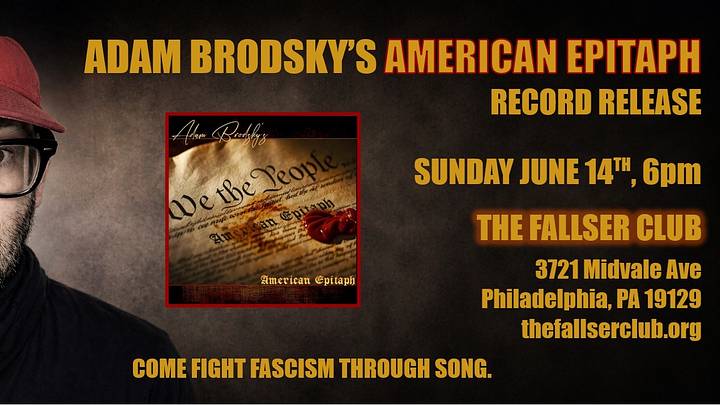
In times of national crisis, it is often the soldiers and the singers who man the front lines. The soldiers fight the external battles. The singers, and associated storytellers, graphic artists and comedians, wage internal war for the culture’s soul.
And so it is in a time of war, both abroad and at home, that Adam Brodsky has returned to the recording studio for his first feature album in twenty-plus years. It arrives officially on June 14, and it arrives none too soon.
The Philadelphia-based Brodsky has been one of the most respected members of anti-folk’s second wave. If that term means nothing to you, don’t feel bad. Even serious music fans, especially those outside New York, have at best a vague knowledge of the genre. If you talk to enough anti-folk artists, you’ll soon realize that even they are unclear of what it all means.
Adam Brodsky takes dead aim at MAGA America in American Epitaph
I prefer this oversimplified definition. Anti-folk musicians tend to be singer-songwriters who carry acoustic guitars and sing songs of personal discovery and protest. In other words, they are very closely aligned with traditional 1950s/’60s folkies.
But anti-folk artists grew up listening to Ramones and Sex Pistols. Their brand of folk is filtered through punk rock. It isn’t truly “anti,” but it does tend to be coarser, edgier, and, often times, a lot funnier than the earnest “Tom Dooleys” of the world.
Which again brings us back to Adam Brodsky.
Brodsky began releasing albums in the mid-1990s. That was about a decade after a group of New York musicians had launched the anti-folk scene. The first generation of artists achieved some modest success outside the NYC area. Cindy Lee Berryhill, Roger Manning, Kirk Kelly, and Paleface all signed with labels and released albums in the late 1980s.
So did Texan Michelle Shocked and, not long after her, a SoCal musician named Beck, who had developed his eclectic craft with anti-folk players in the East Village.
One of the scene’s primary engines, the artist known as Lach, revived his famous anti-folk hoots at the Sidewalk Café in 1993. He had helped launch the scene ten years earlier out of his own apartment. The Sidewalk Revival, fueled in part by Beck’s raging success, opened a new era for anti-folk. Soon, the Moldy Peaches and Regina Spektor would be making noise.
Brodsky was right there with them. His music drew from plenty of sources – the social consciousness of Woody Guthrie, the brilliant wordplay of Tom Lehrer. He was usually just singing along to a guitar and harmonica, which we all just assumed came from Dylan. And he could write with the warmth of John Prine.
If you care to seek it out, there is a four-hour video floating around online of the many performers at the 1999 Anti-Folk Festival in Tompkins Square Park. Lach is there. So is Kirk Kelly. The Moldy Peaches. Lenny Molotov. Closing out the video – just the last couple of minutes – is Brodsky. He engages the crowd in a sing-along – a lovely remembrance of his youth entitled … “Hookers and Blow.”
Back then, Brodsky was mixing the political, the personal, and the profane in the most entertaining way a guy with a guitar and harmonica can hope to. He put out three albums right around the turn of the millennium.
The last album of new material – Hookers, Hicks & Heebs – came out in 2002. Since then, he has remained active, touring extensively. But he was not inspired to release a new original album until now.
I was fortunate enough to hear most of the new album at an intimate gathering in the home of Paul Eckert in the heart of the nation's capital. Eckert has been running a series of house concerts under the name Lucky Penny for many years now
American Epitaph has 13 new songs, most of which comment directly on the political situation America finds itself in in 2026. It still features a lot of acoustic guitar and harmonica, but he is beefing up the sound on many of the tracks with electric guitar from Jesse Lundy and some very cool horns. As for the subject matter…
Brodsky is not pulling punches. On the lead track “Achy Breaky America,” he admits that the country he grew up in was...
“Not perfect, not even close, but look at who we strived to be We were the good guys on the right side At least that’s how they taught it to me.”
He laments the disappearance of those days when
“It used to be we’d all agree Nazis bad and vaccines good.”
If the message wasn’t clear enough, the second track is “Nazis in the White House.” Brodsky references Woody Guthrie (it will not be the last time) and puts the value of singing protest songs into perspective…
“Singing songs and marching may not change my country, but I still do it every day so my country don’t change me.”
That sentiment recalls something the great American songwriter Todd Snider – an anti-folk singer in everything but name – was fond of saying.
“I didn’t come down here to change y’all’s mind about anything. I cam down here to ease my own my mind about everything.”
Brodsky recognizes his side is fighting an uphill battle, and maybe singing isn’t job one on the to-do list. But it is certainly on there somewhere. And it is certainly better than doing nothing.
“New World Order” is one of most rocking songs on the album, and also one of the most tragic. It is a doomed love song that concludes, should you be foolish enough to fall for someone outside your own echo chamber…
“Love knows no boundaries, time, or border Love is a crime in the new world order.”
Both “Good Enough” and “Gainesville” could be Prine songs. They operate on a personal level, though the political still hovers like a specter in the background, and they treat regular victims of senseless cruelty with dignity and compassion that can bring tears. Brodsky doesn’t have to lean on his humor to make a point.
But when he wants to…
You get gems like “Daddy Issues,” which exists in two distinct versions. On the album, it is a personal story about … well, you can probably guess. But he has reworked it into a political statement for live performances as well.
And on “Johnny Cash,” he rivals the legend’s “I’ve Been Everywhere” velocity, laying out a Raymond Carver-esque story of intertwined fates with more internal rhymes than “Rap God.”
“Don’t Break Bread” and “Do Not Go Gentle” are both calls to arms for a frustrated population looking to reclaim a country. The former observes …
“I used to wonder how the Germans let it happen Let’s just say I don’t wonder anymore.”
And the latter, in Brodsky’s unique voice, references the stubborn refusal of baseball greats Steve Carlton and Ricky Henderson to hang up their spikes as a segue into a rallying cry for anti-fascists to fight to the bitter end.
On “King of Antifolk,” he offers a decidedly unglamorous – but wickedly funny – history of the genre, name-dropping Brenda Kahn and Roger Manning among others. And on “2020” – aided by some awesome New Orleans-style horns – he calls directly on Woody Guthrie.
“The Prophet said this land was made for you and me.”
Maybe so. But if it were, Brodsky sees us at a crossroads and sees a battle worth fighting. Tom Morello’s Power to the People festival, planned for October, sold out Columbia, Maryland’s Merriweather Post Pavilion in what seemed like 30 minutes.
Bruce Springsteen, who will be joining his friend Morello, along with a great many other top-tier musicians, has been selling out arenas and stadiums all spring. Steve Earle said he was inspired enough to rerelease his inclusive song “City of Immigrants” with a brand new video.
And now Adam Brodsky is joining the fight. His guitar and his pen remain potent weapons in America, 2026.
I’m going to share one tiny little story because, 1 - I think it says something about the world we are in, and 2 – I think it’s hilarious.
In the rapid-fire lyrical ping pong on “Johnny Cash,” Brodsky ends up quoting himself with the line “the chick I dig digs chicks.” (A favorite lyric of Kris Kristofferson.) Being the diligent writer that I am, I wanted to make sure I had the words and the song right, so I typed that phrase into my search bar.
AI quickly offered me the following…
“It sounds like you’re experiencing a complicated crush where the person you like is interested in someone else. This is a tough spot, and taking some space to navigate your feelings in a valid approach.”
Yeah – I’m not all that worried about AI replacing writers like Adam Brodksy.
 Add us as a preferred source on Google