

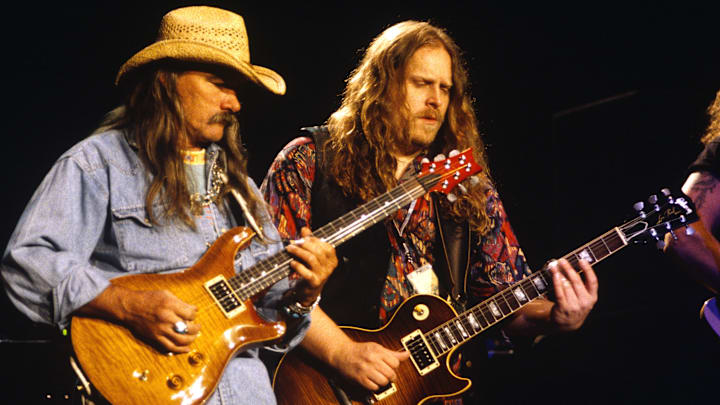
We don’t really know where the Allman Brothers would have traveled had guitarist Duane Allman not died in a motorcycle crash at the age of 24. Just over a year later, bassist Berry Oakley, also 24, died. Also, in a motorcycle accident. The 1970s had barely begun, and it looked as if ABB was at their proverbial crossroads.
Before the twin tragedies, the band from Jacksonville, Florida, was carving out new terrain in the still evolving world of rock and roll. Southern rock did not exist prior to The Allman Brothers Band, released in 1969.
Their music combined the swampiest of rhythm and blues with jazz and funk influences that expanded the palette of modern pop. It is no overreach to say that the Allman Brothers are on the shortlist of most influential American rockers – on the same Mt. Rushmore as the Beach Boys, Velvet Underground and Frank Zappa.
Duane’s spectacular slide guitar and Oakley’s ability to be both melodic and rock steady (you’re not a jam band without a really good bass) were ever-present in the band’s early albums. But they were a formidable group, even after they lost two of their founding members.
The best of latter-day Allman Brothers
Duane’s brother Gregg was just about the best blues rock singer of his era and he grew into an excellent songwriter. Dickey Betts, who provided the era’s preeminent twin lead attack with Duane, was still around to serve up glorious riffs and solos. The double drums still sustained the wildest of musical forays.
They added Chuck Leavell on piano after Duane’s death and ended up producing their most successful album Brothers and Sisters in 1973. But creative differences, changing tastes and the general stress of losing Allman and Oakley eventually wore the band down. They split up for a while, reformed and ended up releasing one more strong album in 1979’s Enlightened Rogues.
Then the bottom seemed to fall out. Two lukewarm stabs at synth-driven new wavy rock seemed to end the great band’s run for good in the early ‘80s. But they returned again. The Allman Brothers still had great songs to perform. Here are ten of the best from the second half of their career – from 1980 on. These may not be as well-known as their sensational early ‘70s output, but they are all well worth a listen.
10. “Firing Line” from Hittin’ the Note (2003)
The final formal studio album came almost a decade after their previous studio recording. By this time, guitarist Dickey Betts was gone. Instead of Dicky and Duane, Warren Haynes and Derek Trucks were handling the dueling guitars. And doing it beautifully.
This Greg and Warren composition veers toward the funkier side of the ABB sound, a vibe they had been indulging in late in their career. It still had those powerful vocals from Greg over the wailing guitar.
9. “Kind of Bird” from Shades of Two Worlds (1991)
Almost every ABB album featured at least one prolonged instrumental jam. This one was a collaboration between Betts and Haynes, with some strong input from Gregg’s Hammond organ. It has the clean guitar lines that the band had always been known for, along with mad dashes into the jazziest side of southern rock.
8. “Sailin’ ‘Cross the Devil’s Sea” from Where it All Begins (1994)
Glorious country funk with Gregg in fine voice and Allen Woody pounding out an unstoppable bass line.
7. “Things You Used to Do” from Brothers of the Road (1981)
OK – Brothers of the Road is not much of an ABB album. It was from that dark time in the early ‘80s when they seemed to be chasing pop success. But Gregg was still capable of writing a great song and the band could still crank out hard-charging rock when they had good material.
6. “What’s Done is Done” from Where it All Begins (1994)
Gregg and Allen Woody combined on this one and it could have easily showed up one of the albums from the glory days and no one would have known the difference. Greg had always been a songwriter with an old soul, and as he grew older and dealt with addiction, tragedy and failure, those songs took on an even deeper shade of soul.
5. “True Gravity” from Seven Turns (1990)
Seven Turns is the best of the late ABB albums and this spacy fusion jam rivals some of their great early instrumentals. It doesn’t rock in the same manner but it throws so many melodic colors at your ears that it is impossible not to get lost. Dickey’s son Duane joins his dad and Warren Haynes in the gorgeous guitar attack.
4. “Desert Blues” from Shades of Two Worlds (1991)
Gregg was ceding some control by Shades of Two Worlds. Betts and Haynes took on a more dominant role. That is why Dickey sings this song that really probably would have been better with Gregg on vocals. Nevertheless, it is a virtually perfect blues shuffle with stabbing solos and a beat that just refuses to let up. Some of the best Non-Duane slide work the band ever did.
3. “Good Clean Fun” from Seven Turns (1990)
Greg kicks off Seven Turns with a vengeance in this powerhouse blues rocker that bristles under the oxymoron of the title.
2. “Nobody Knows” from Shades of Two Worlds (1991)
A titanic 11 minutes that Betts would keep alive after he left the band. You really get the full effect of what ABB did best – powerful blues rock from Gregg, combined with a tight yet expansive jazz rock journey.
Gregg supposedly did not like singing it, and it left the band’s rotation with Betts, who composed the song. There are a lot of words and a lot of notes, and in the hands of less gifted musicians, this would have felt pretentious. With ABB, it feels just right.
1. “Soulshine” from Where it All Begins (1994)
The Allmans aren’t always known for the beauty in their songs, though they created some of the most beautiful music to be found in early ‘70s rock. They did it again with this sumptuous Warren Haynes number. This is closest Gregg ever came to sounding like Van Morrison. That gritty beauty, along with some lovely guitar work, makes this one of ABB’s greatest songs, regardless of era.
 Add us as a preferred source on Google