

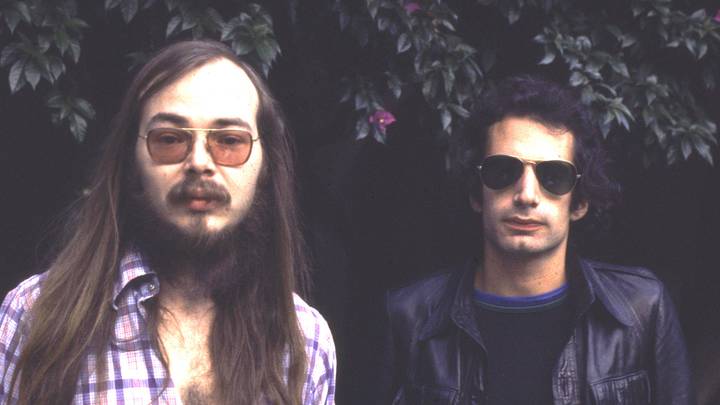
The following are review snippets that came courtesy of some of the leading rock critics of the day, Mark Coleman, Rick Clark, and Robert Christgau, respectively. They were opining on the fifth studio album of Steely Dan, The Royal Scam, released fifty years ago:
Coleman, from the 1993 Rolling Stone Album Guide, “Bitter tales of drug burns and emotional bailouts can leave a harsh aftertaste.”
Clark, from the 1992 All Music Guide, "Cluttered, abrasive-sounding collection of tracks, which were further undermined by weaker melodies."
Christgau, from his official website, "A trifle arty, and a trifle producty at the same time."
This was the same Robert Christgau who had declared Pretzel Logic, the band’s third album, the very best of 1974 (though he would later backtrack just a bit from that assessment). Clearly, The Royal Scam touched a nerve. Not a pleasant one for many.
Steely Dan’s greatest forgotten album
And yet there are those of us who hold the collection of bitter tales of crime and infidelity close to our hearts. We are a minority, but a visible one. And we believe with a passion that The Royal Scam needs to be rescued from the purgatory it has lived in for the past fifty years.
I am not going to try to convince you that The Royal Scam is Donald Fagen and Walter Becker’s greatest achievement. That would be the aforementioned Pretzel Logic. Nor was it their second-best album. That is 1975’s Katy Lied.
I personally have The Royal Scam third on my list, which makes that run from 1974-1976 pretty damn special. I understand all too well that I have already lost half the Steely Dan fans out there by not bowing down at the altar of Aja, the album that succeeded The Royal Scam in 1977 and which is embraced by audiophiles and jazz lovers the world over. Just not by me.
I have tilted at that windmill for years and lost friends over it. (Not good friends, mind you, but what passes for online, virtual friendship these days.) I’ll probably come back to Aja before this is over. I can’t help myself. But I will keep the comparisons to a minimum. I come to praise Scam and not to bury Aja.
Is The Royal Scam bitter? Yes. Horrors! A rock and roll album with an acid tongue. Whoever heard of such a thing? This was one year after Dylan released Blood on the Tracks. One year before Fleetwood Mac’s Rumors. Three years after Lou Reed’s Berlin and one year before the Sex Pistols.
Being bitter did not prevent any of those albums from winning critical praise. Of course, there are different ways of presenting bitterness. Folk and punk – OK. Jazz rock, apparently not so much.
People who don’t like The Royal Scam feel the emotions are too brittle. The music is too pretty to match the feeling. The melodies – at least to Mark Coleman, too undercooked.
I respectfully disagree.
That is not to say the album is perfect and that every track sparkles. There are nine tracks, and two of them aren’t very good. That is what keeps it in third place on my list. They come dead center – last song on side one, first song on side two.
“The Fez” is an intriguing failure. A nod toward disco, it is the one Scam song on which Fagen and Becker shared writing credit. Keyboard player Paul Griffin developed the melodic line. The minimalist lyrics add little to the song. It might have been a clever two-minute throwaway. As it was, it ran four minutes and was the second single released, to very modest success.
“Green Earrings” is worse. Also clocking in at four minutes, this is one where Clark’s “weaker melodies” complaint is undeniable.
The other seven songs, to me, all sparkle.
It begins with one of the two best singles Fagen and Becker ever created – “Kid Charlemagne. The rhythm section of Chuck Rainey (bass) and Bernard Purdie (drums) creates a sensational funk groove from the opening beat. Fagen’s insistent vocals paint a clear picture of an outlaw.
Then you get to the middle, and Larry Carlton’s hyper-tasty guitar solo takes over. After the first solo, the guitar sticks around, stabbing into the final verse before finishing with a second solo.
When Fagen and Becker decided to stop touring and essentially end Steely Dan as a multi-member collaborative band, this is exactly what they were envisioning. Those players were all virtuosos who delivered exactly what was required. The urgency inherent in "Kid Charlemagne” blends with the pristine jazz rock to create a masterpiece.
They will follow it up with more tales of outlaws on side one. Carlton's opening guitar riff on “Don’t Take Me Alive” sets up a much darker hostage situation, but one that is no less urgent.
And the perverse fun of the outlaw colony on “Mizar 5” chronicled in “Sign In Stranger” combines the boys' penchant for offbeat poetry – “Would you like to take a yo-yo for a ride” - with Griffin's wandering piano in the quirkiest of manners.
Wedged in the middle of the outlaw stories, we get the lovely “Caves of Altimira.” It may be wistful, lamenting the lost days before artistic expression was entirely commodified, but it is far from bitter or acerbic. With its horn setup and John Klemmer's sax solo, it is one of the prettier songs the boys ever produced, and it provides some very nice balance to the darker entries.
After the mid-album hiccup, Fagen and Becker hit their stride with three more remarkable songs. The first two are supremely bitter. I admit that. They are about love affairs that crash and burn. The characters do not behave in a mature fashion. That’s what makes them potent.
If you want to make claims of cringeworthy appropriation for “Haitian Divorce,” I can’t really dispute that. The borrowed reggae beat. The “Charlie with the lotion and the kinky hair” who will provide sexual liberation for the unhappy housewife. Cringe if you must. What I love about this song is how Fagen doesn’t settle for half measures. He dives in.
Becker runs Dean Parks’ excellent guitar solo through a talk box to create an instantly recognizable sound. Fagen belts out the final punch line, “who’s this kinky so-and-so,” with gusto.
They even manage to insert some distancing lyrical content that emphasizes how the world – even the rawest of human emotions – exists behind a Hollywood-generated sheen – “now we dolly back – Now we fade to black.”
This was one year before Elvis Costello would use the same technique in “Watching the Detectives.” (Which, let the record show, is as emotionally bitter as you can get.)
If anything, “Everything You Did” pushes the perversity even farther. Pleasant? No. But I do not know of a better maniacal cuckold song. If you are aiming for an extreme, make sure you do it better than anyone else.
It all concludes with the bitterest and bleakest song Steely Dan ever did – the title track. I can’t tell you why I find similar songs ponderous and this one riveting. It is six-and-a-half minutes, highly evocative and cinematic in scope and story. But it is also redundant, so if you are not buying what it is selling, you won’t hold it in the same regard.
To me, it paints a perfect picture of those who have been left behind in the modern Western world, and who perpetuate that inequity by maintaining that they are better off than the ones they, in turn, left behind. This is the meaning of the royal scam, and I find it impossible to ignore.
Like I said, you may not share the view. That’s fine. There’s a website called Digital Dream Door that compiles tons of music lists. Of course, I take issue with plenty of them but I find they do a very nice job on the whole. Not with this album though.
DDD ranks the 100 (or more) best albums of each year from the dawn of the rock era, and The Royal Scam is the lowest-ranked album from Steely Dan’s discography. They had it at number 71 in 1976.
Seven of their nine albums ranked in the top 50, including the two released after their long hiatus in the early 2000s. I’m sorry, that doesn’t compute for me. (I take some solace in the fact that the only other Dan album to fall out of the top 50 in its year was Katy Lied, which seems equally ludicrous to me.)
OK – let me conclude with the Aja thing. Many fans and critics alike consider Aja, the album that came after The Royal Scam, to be their best work. (DDD has it as their second highest-rated, behind Pretzel Logic.)
Rolling Stone magazine ranked every single Steely Dan song last year. I suppose your particular brand of fandom can be summed up by your reaction to their top two choices. “Kid Charlemagne” ranked second. “Deacon Blues,” from Aja, was first. “Deacon Blues” is fine.
I certainly don’t hate it. But it also strikes me as the song that was created as a direct result of all those critics calling The Royal Scam bitter and arty and whatever else they said.
Aja is pristine. But it doesn’t have one-tenth of the energy and urgency that pulses through The Royal Scam in bursts of static electricity. Static electricity may not be pleasant, but it demands your attention.
I just know that I will listen to “Kid Charlemagne” a dozen times before I listen to “Deacon Blues.” I’ll do the same with “Haitian Divorce” and “Aja.” The first seems perfectly suited to Donald Fagen’s imperfect voice, while the latter is an incongruent hash.
“Peg” and “Black Cow?” Good songs, sure. But I’d prefer spending time in the caves of Altamira or at the freak show carnival on Mizar 5.
Again – to me, and only to me – The Royal Scam boils and bubbles where other cleaner albums simmer. It revels in the decay of life. It is imperfect, and it is great. It is time for us to recognize that.
 Add us as a preferred source on Google