

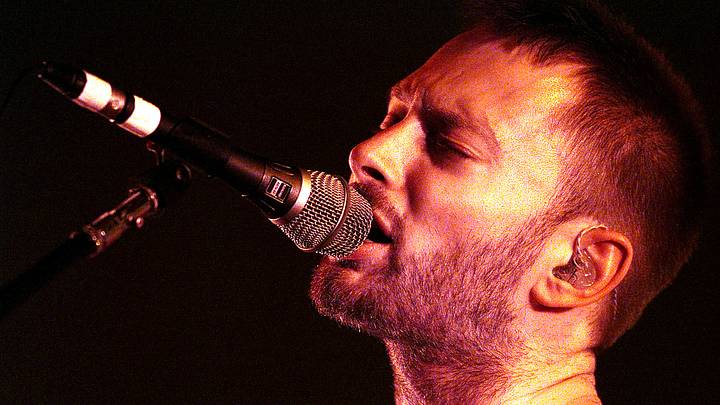
I have tried for decades to like Radiohead’s Kid A. Not “love.” Not elevate it into the all-timer status that its most ardent fans claim. I have just tried to enjoy the actual process of listening to the Brits’ fourth album, which was released in 2000. Once every few years, like clockwork. I have never been successful.
Until yesterday.
I am not claiming to be a late-arriving convert. I am not rewriting my own top-whatever list to make room for it. It’s just that, in a very small way, I think I sorta-kinda get it today a little more than I did last year. And I’ve been trying to figure out why.
Where do you put Radiohead's Kid A on your all-time album list?
Have I changed? Has the world around me changed? Has the music somehow changed? That would be the least likely, right? But I feel like it’s worth considering. And I have indeed arrived at an answer, though I’m not sure it’s a satisfying one.
I know full well why I haven’t liked this album for the past two-and-a-half decades. I was born too early.
That, of course, is not a complete answer. Our surroundings may influence, but they do not determine. Still, coming of age – in terms of musical tastes at least – in the early 1970s left me with a predilection for classic rock and roll built on guitar riffs, strong rhythm, and songs. The “songs” part is crucial. Radiohead hasn't really been a "songs" band since "Creep" in 1992.
Concept albums may have been around since the mid-1960s, but the unit of measure in my early days was still the single. It had a stand-alone structure. It did not need external context. “Stairway to Heaven” may have been lyrically impenetrable, but you didn’t need to listen to all of Led Zeppelin IV to get it.
I also grew up in a time of protest. I had older brothers who introduced me to iconic ‘60’s performers. Their enemies – Richard Nixon, the Viet Nam War, segregationists – became my enemies. They were easily identifiable.
Thom Yorke is only a half-a-decade younger than me, but he grew up in a very different era. The Radiohead frontman came of age in the late ‘70s, when protest had been replaced by boredom. And when technology began its unavoidable march to global domination.
I don’t mean to suggest that technology has not always been a potent antagonist for artists. The friction spelled out by Levi-Strauss in The Raw and the Cooked has always been around. Or at least it has been around for as long as we’ve bothered to record our thoughts on man’s nature.
I don’t doubt that back in the day there was a cave dweller who lamented the advent of cooked mammoth the same way my friend Simon despises the arrival of e-bikes and pedal assist.
Yorke also grew up in England and was probably much more open to synthesizers and electronica than I was here in the USA. Kraftwerk barely registered when I was a lad.
All that said, it makes sense that Yorke would gravitate toward a different kind of music than the one I knew. I have long suspected that the people who laud Kid A (and The Bends and OK Computer … basically, everything after Pablo Honey) are younger than me. They are more open to Yorke’s music and more intrigued by the general concept of amorphous identity.
I should note at this point that I have always enjoyed a couple of tracks from Kid A. I can’t deny that “Idioteque” has a certain majesty. My favorite track, probably to the chagrin of its many fans, is “Optimistic.” That may be the most traditional song on the album.
For me, much of the rest of the album has ranged from curiosity (“National Anthem,” “Motion Picture Soundtrack”) to pomposity (“Treefingers,” the title track).
What changed yesterday? In a small way, I have changed. I’ve always known that I can’t listen to Kid A piecemeal. It is not one of those albums where you can choose any track at random and get the proper experience. You really have to listen to it in order and in its entirety. I have become ever-so-slightly more patient as I have aged and am willing to do that more than in the past.
But I think the more important new variable may come from external context. Whether this was mere coincidence or whether there was a phantom thread binding my actions into a whole, I listened to Kid A after reading up on the current debate over AI and after stumbling upon 2001: A Space Odyssey on late-night TV.
I’m a modest sci-fi fan. I have never taken the threat of technology nearly as seriously as some others. I’d like to think I am smart enough to understand technology’s broad impact on human culture, but I tend not to dwell on it.
I think Kid A does, and I think I am only now beginning to understand why it means so much to so many people younger than me, who grew up in a world dominated by computer culture. I doubt I will ever love this album, but I hear more relevance in it today than I did yesterday. And that is somehow encouraging. In a very real way, it means we can change.
I did not sit down to write this to change your mind about Kid A. If you love it, you probably think I am just dense. If you hate it, you may accuse me of succumbing to the emperor’s new clothes ethos. That, or just trying to look cool to younger generations. There are elements of truth in both assessments.
I am reminded of something the late, great Todd Snider was fond of saying.
“I didn’t come down here to change any of y’all’s minds about anything. I come down here to ease my own mind about everything.”
I thank you for letting me work this out in public. And maybe, if this resonates at all, check out an album you long-ago decided was over-hyped and not your thing. It doesn’t have to be Radiohead. That’s my thing. Find your own and check out whether you … or the world around you ... has changed.
 Add us as a preferred source on Google