

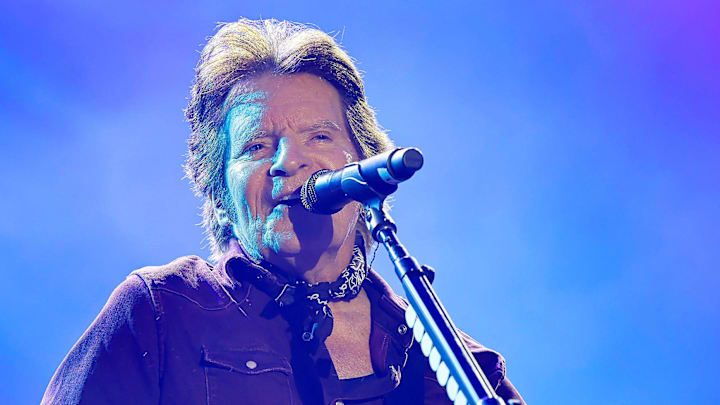
John Fogerty, iconic frontman of Creedence Clearwater Revival, who launched a successful solo career after the breakup of the band, has been awarded the prestigious Johnny Mercer Award for 2026. The award is open to inductees into the Songwriters Hall of Fame.
Mercer, whose credits include classics from “Hooray For Hollywood” (1937) to “Moon River” (1961), as well as a series of jazzy standards with composer Harold Arlen, co-founded the SHOF in 1969. Fogerty was inducted into the Hall in 2005, and with his Mercer Award, he joins illustrious artists from Steven Sondheim to Paul Simon in claiming the Hall’s highest honor.
Fogerty was the primary songwriter – as well as the lead guitarist and vocalist – for Creedence in the late ‘60s and early ‘70s. The band gradually came into being in the early-to-mid ‘60s with Fogerty’s older brother Tom on second guitar, and a rhythm section consisting of Stu Cook on bass and Doug Clifford on drums. After seven very successful albums released between 1968 and 1972, they broke up, and Fogerty began his solo career.
That solo career has yielded eleven more studio albums, which have featured a mix of new and old material. His best-known solo album, Centerfield, topped the charts in 1986.
John Fogerty’s greatest songs
Today, we attempt the impossible. Ranking John Fogerty’s 15 greatest songs. I promise you in advance, if you are a fan of his discography, you will be angry about some of my choices… especially with some of the songs I have left out.
To prepare for this, I asked a bunch of friends about their favorite Fogerty songs. I was surprised by how many of them kind of shrugged. They all liked a handful of CCR songs, but they also asked if he really deserved the Mercer prize.
Then I started listing the songs he has written. When I got to ten, they’d invariably nod and admit that he was indeed a talented and prolific writer. When I reached 20, they’d express genuine surprise. “I didn’t realize he had written that many great songs.”
By the time I got to 30, they were reassessing their entire worldview. I’ve come to believe that Fogerty’s songs do not cover as wide a range as the work of, say, 2015 Mercer winner Van Morrison. And that may lead to some undervaluing.
If you just hear “CCR” and think swamp rock, I can understand that. But within the broad confines of a blues-based, southern rock, Fogerty achieved magic. And nuance. He wrote upbeat sing-alongs and songs of existential dread. He wrote flat-out rockers and doom-drenched ballads.
When he moved too far afield of the swamp, he did occasionally falter. But he also had unlikely successes. The fact is, anyone who puts out as much material as John Fogerty is going to have some lesser efforts. Some redundancy. Don’t let any of that distract from the wealth of simply superb rock & roll songs that came from his pen.
It was too painful to limit this to 15 songs without acknowledging another 15 that are just as good. Shunting them off into the Honorable Mention category is purely a matter of personal taste.
Honorable Mentions
“Proud Mary” (1969); “Green River” (1969); “Ramble Tamble” (1970); “Travelin’ Band” (1970); “Run Through the Jungle” (1970); “Born to Move” (1970); “Have You Ever Seen the Rain” (1971); “Hey Tonight” (1971); “Sweet Hitch-Hiker” (1971); “Rocking All Over the World” (1975); “Centerfield” (1985); “Change in the Weather” (1986); “Hot Rod Heart” (1997); “A Hundred and Ten in the Shade” (1997); “Long Dark Night” (2007)
15. “Born on the Bayou” from Bayou Country (1969)
On their self-titled debut, CCR established themselves as a blues rock powerhouse with covers of songs by Screamin’ Jay Hawkins, Wilson Pickett, and the ground-breaking Dale Hawkins’ number “Suzie Q.” On the follow-up, most of the covers were gone, replaced by almost all Fogerty originals.
He announced the band’s identity right up front with the first track, “Born on the Bayou.” He may have actually grown up just north of Berkeley, California, but John Fogerty’s musical soul was deep in the bayou swamps.
14. “(Wish I Could) Hideaway” from Pendulum (1970)
Pendulum, CCR’s sixth album, was originally denigrated as a more ponderous effort coming on the heels of the sensational Cosmo’s Factory. But it has grown in reputation over the years for containing some of Fogerty’s most heartfelt compositions.
The organ that leads us into the mournful “Hideaway” gives the song a gospel flavor which occupies a musical space more reminiscent of Nina Simone’s original take on “Don’t Let Me Be Misunderstood” than the harder-rocking Animals’ version a few years later. It contains some of Fogerty’s most expressive singing while a part of CCR.
13. “Rock and Roll Girls” from Centerfield (1985)
Though he could be angry, or mournful, or downright scary, Fogerty could also write flat-out perfect happy rockers, as he did to outstanding effect on his breakout solo album, Centerfield. He even tosses in a sax solo.
12. “Blueboy” from Blue Moon Swamp (1997)
Centerfield is undoubtedly Fogerty’s best-known solo album. To many of his old fans, Blue Moon Swamp is his best. On this track, he has Donald “Duck” Dunn and Chester Thompson providing the swampy funk on bass and drums, while also getting backing vocals from the legendary Waters family.
11. “Commotion” from Green River (1969)
By their third album, CCR was a fully mature hit factory. “Commotion” drives forward with an unrelenting momentum that doesn’t require volume or lightning speed to crank up the pulse.
10. “The Wall” from John Fogerty (1975)
Fogerty surprised many of his fans when he released his debut album, The Blue Ridge Rangers, in 1973. The great songwriter put out an album covering classic American songs, leaning heavily into country and bluegrass. The next album returned to originals, including this stomping blues workout released several years before Roger Waters claimed the concept of the wall for Pink Floyd.
9. “Up Around the Bend” from Cosmo’s Factory (1970)
CCR fans debate their favorites, but it’s hard to utter a bad word about Cosmo’s Factory. Fogerty did choose some covers – the likes of Bo Diddley and Motown’s Whitfield and Strong – but the core are the seven originals penned by Fogerty, five of which charted in the top ten on the Billboard singles chart. It opens with the hookiest of chord slides before galloping joyously forward.
8. “Who’ll Stop the Rain” from Cosmo’s Factory (1970)
Another stellar cut from Cosmo’s Factory, “Who’ll Stop the Rain,” may be Fogerty at his most wistful. Fogerty alternated between writing songs of immediate political significance and songs that used more timeless tropes. Here, he combines both with lyrics that are clearly derived from the Woodstock generation, but also uses historical and allegorical imagery. It is simply a beautiful song about yearning for an end to the madness.
7. “The Old Man Down the Road” from Centerfield (1985)
Lyrically, the opening track of Centerfield may not rank with the poetry of “Who’ll Stop the Rain.” But its lyrics do perfectly embody the swampiest of all Fogerty’s solo singles. And that simple interplay between guitar and bass makes this unforgettable. If William Faulkner wrote rock songs, this is what he’d write.
6. “Lookin’ Out My Backdoor” from Cosmo’s Factory (1970)
Having already included three other Cosmo’s songs as honorable mentions, I can tell you now that this will be the final song from that album. And it shows beyond any doubt that for a songwriter who was unafraid to tackle more serious, potentially difficult subjects, John Fogerty could revel in the pure joy of tambourines and elephants – indeed, the wide spectrum of musical emotions – as well as anyone.
5. Déjà Vu (All Over Again) from Déjà vu (All Over Again) (2004)
There’s no denying that Fogerty’s product fell off in the late 1990s. 1997’s Blue Moon Swamp provided his last great collection of original material. But he was still capable of penning masterpieces. Déjà Vu begins with an angry acoustic guitar and sets up the listener for a ‘60s’ style protest number. Then Fogerty’s voice – sweeter than it had ever been – does in fact begin a protest, but it is a poignant and sorrowful one that strikes deep.
4. “Bad Moon Rising” from Green River (1969)
Everything I said above about ”Lookin’ Out My Back Door” applies here. This one scores even higher since the subject matter is, as the lyrics say, rage and ruin. Writing upbeat, catchy tunes about dire subjects gets at the heart of the best of American music.
3. “Down on the Corner” from Willy and the Poor Boys (1969)
This is the first time I have mentioned CCR’s fourth album. That’s partly because several of its best tracks, like “Cotton Fields” and “Midnight Special,” are covers. And partly because .. well, more on that in a minute. This is simply the most infectious song Fogerty ever wrote. I don’t even mind that for the first 20 years of my life, I had no idea what he was actually signing when he got to “Willy and the poor boys are playing – Bring a nickel, tap your feet.”
2. “Lodi” from Green River (1969)
I’m not sure everyone likes “Lodi” as much as I do. It’s clearly a great song, but I can see where the downbeat rhythm and message might not inspire the same passion that some of Fogerty’s bigger tunes might.
I’ve always found the simplicity of the lyrics – “Things got bad, and things got worse, I guess you know the tune” and “Somewhere I lost connection, I ran out of songs to play” to be majestic. Maybe because they comment directly on the songwriting experience using the language of the craft itself. Whatever the reason, I am always profoundly moved by the sadness of “Lodi.”
1. “Fortunate Son” from Willy and the Poor Boys (1969)
This is one reason why WATPB was not mentioned until recently. I think it contains two of Fogerty’s three greatest songs. “Fortunate Son” is a tidal wave. It is among the greatest rock protest songs ever written. It is both an angry manifesto and an anthemic sing-along. It is that rare piece of art that can be claimed by all sides in an argument – and has been.
 Add us as a preferred source on Google